About Hypogymnia enteromorpha (Ach.) Nyl.
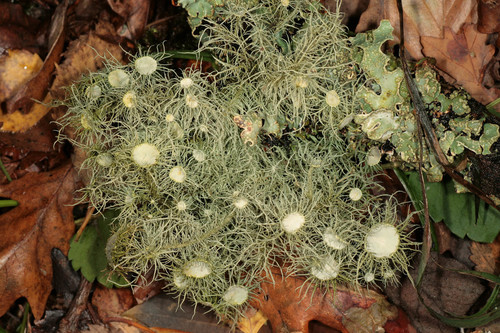
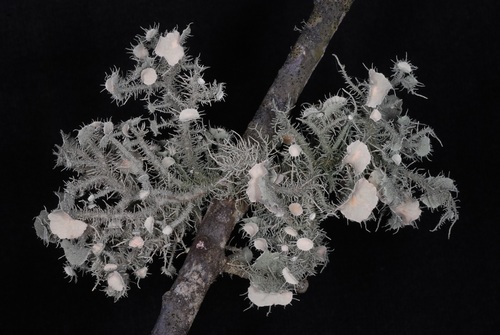
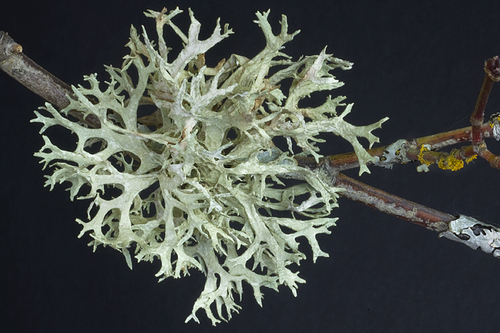
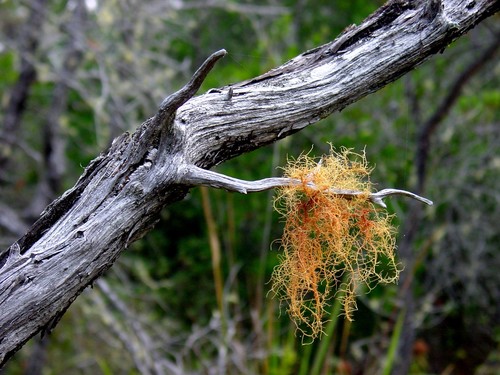
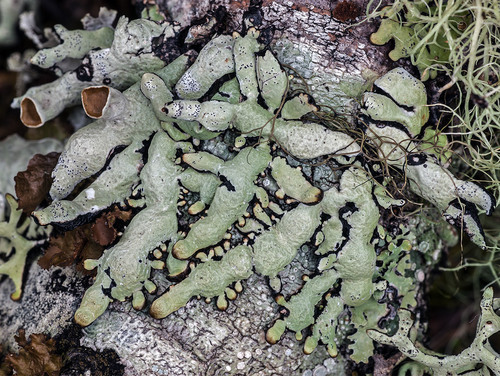
Hypogymnia enteromorpha, commonly called the budding tube lichen and gut lichen, is a medium to large foliose tube lichen. Its lobes range in color from pale whitish-gray to pale greenish-gray. The whole thallus typically measures 5–15 cm (2–6 in) across, with individual lobes commonly 2–6 mm (1⁄16–1⁄4 in) wide, sometimes reaching 5–10 cm (2–4 in) in length. The lobes are inflated and hollow, and may either drape from their growing substrate or lie pressed against it. On more level surfaces, lobes are often shorter and rounder, while they commonly become elongated on vertical faces. Branching is irregular, and branches alternate between constricted and swollen segments. A cut lobe reveals a dark inner lining of the hollow cavity, matching the lichen’s generally dark interior. Many lobe tips broaden, and some end in a small terminal opening. Small marginal outgrowths are often present, appearing as tiny round lobules or short bud-like side lobes that can be abundant or sparse on a single thallus. The underside of the thallus is black, and the species does not produce soredia or isidia. Apothecia are frequently produced and are typically brown. Chemical spot test results for the medulla are PD+ red (also described as P+ yellow turning red), K−, C−, and KC+ (pink to orange), which corresponds to a chemical profile of protocetraric acid, physodic/physodalic acid, and diffractaic acid. This lichen grows on bark and wood, especially on conifers, where it can grow directly on conifer bark or across dry, weathered wood. It is associated with moist low- to mid-elevation forests, and tolerates sites from fairly exposed to more shaded conditions on bark or wood surfaces. In western North America, it is common and conspicuous in many areas, with a documented range extending from Alaska south to California. It is very common in the western Cascade Range, but becomes uncommon to rare moving east toward the Continental Divide.