About Hypogymnia duplicata (Ach.) Rass.
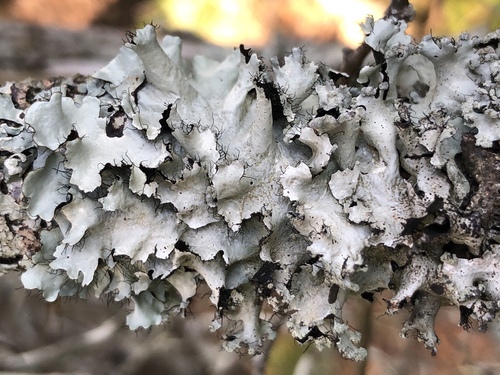
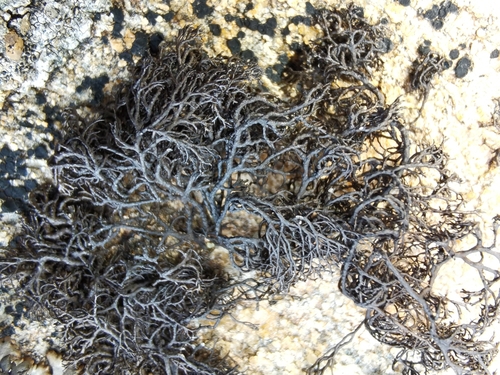
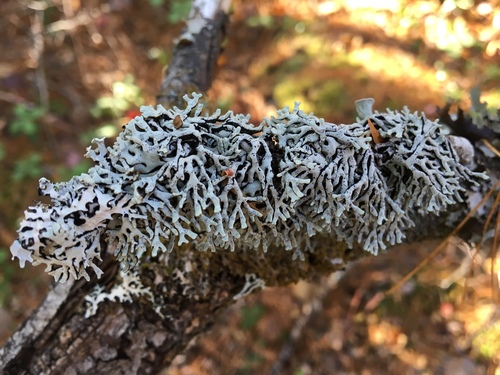
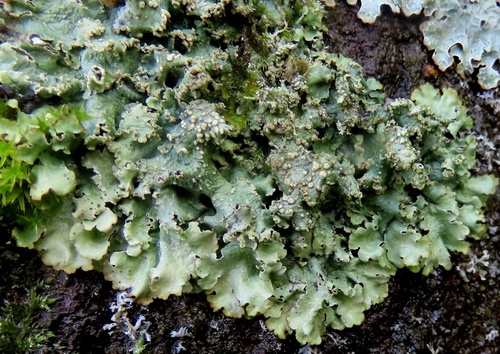
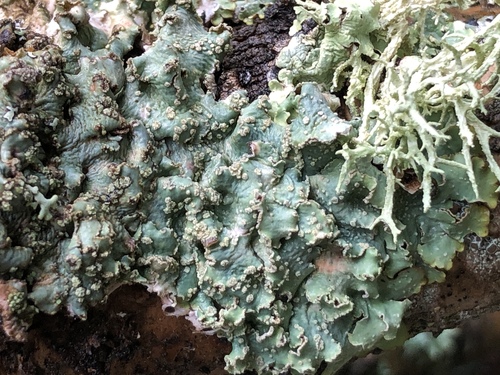
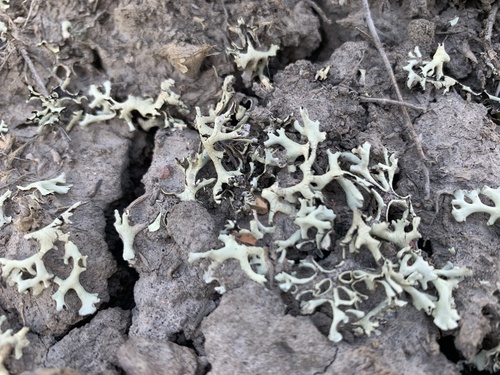
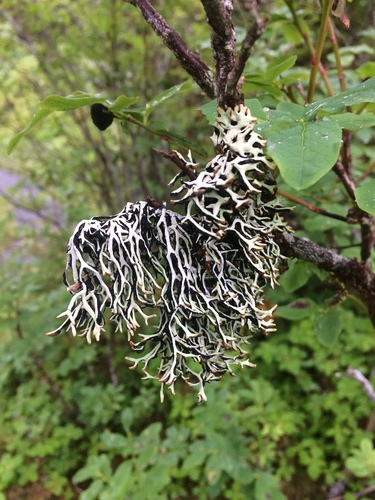
Hypogymnia duplicata (Ach.) Rass. is commonly known as the ticker-tape lichen. It is a foliose lichen that can reach up to 30 cm (12 in) in diameter, though a diameter range of 4–20 cm (1.6–7.9 in) is more typical. This lichen has long, slender lobes that measure about 1 mm wide, with curved branches that may drape from its growing substrate. The upper surface of its thallus is whitish gray to pale greenish gray, while the lower surface is black. Inside the lobes, the upper interior (ceiling) is light, sometimes white, and the lower interior (floor) is dark. Fruiting bodies called apothecia are uncommon for this species, and it does not produce vegetative propagules such as isidia or soredia. Standard chemical spot tests give the following results for the medulla: PD+ (red), K−, KC+ (pink), and C−; the cortex tests K+ (yellow). Secondary metabolites found in the lichen are diffractaic acid, physodalic acid, and protocetraric acid. Hypogymnia duplicata grows on the bark and wood of coniferous trees, most often in fens and coastal bogs. It occurs along the Pacific Coast of northwestern North America, with a range that extends from Alaska in the north south to California. The southernmost parts of its recorded range are Corvallis, Oregon in the Coast Range, and Mount Hood in the Cascade Range. In a 196-plot survey of forests in southeast and south-central Alaska, researchers Root and colleagues recorded Hypogymnia duplicata as a common epiphytic macrolichen. Within this survey dataset, the species was associated with more oceanic coastal conditions, and occurred less frequently in cooler, drier inland locations.