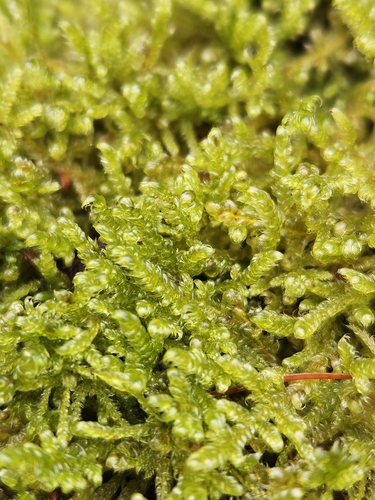
About Hypnum cupressiforme Hedw.
Nomenclature and Classification
Hypnum cupressiforme, commonly known as cypress-leaved plaitmoss or hypnum moss, is a common and widespread moss species belonging to the genus Hypnum.
Global Distribution
It can be found on all continents except Antarctica, and occurs in a very wide variety of habitats and climatic zones.
Growth Substrates
It typically grows on tree trunks, logs, walls, rocks, and other surfaces.
Habitat Preferences
It prefers acidic environments and is fairly tolerant of pollution.
Historical Uses and Etymology
It was formerly used as filling for pillows and mattresses; the association with sleep is the origin of the genus name Hypnum, which comes from the Greek word Hypnos.
Size
This small to medium-sized moss reaches about 2–10 cm in length.
Growth Form
It is pleurocarpous, with prostrate, creeping stems that form smooth, dense mats.
Stem and Leaf Arrangement
Its branched stems are covered in overlapping leaves, giving an appearance that resembles a cypress tree.
Stem Leaf Characteristics
The stem leaves are long and thin, measuring 1.0–2.1 mm by 0.3–0.6 mm. They are concave and sickle-shaped, tapering toward the tip.
Branch Leaf Characteristics
The branch leaves are smaller and narrower than the stem leaves.
Spore Capsule Shape
This moss produces short, cylindrical, slightly curved capsules that contain its spores.
Capsule and Operculum Size
These capsules measure 1.7–2.4 mm in length, and have a lid-like operculum that measures 0.6–0.9 mm.
Spore Stalk Characteristics
The capsules are borne on reddish-brown stalks that are 1–2.5 cm long.
Reproductive System
This moss is dioicous, meaning it has separate male and female plants.
Intraspecific Variation
Numerous varieties of Hypnum cupressiforme have been described, which makes this a highly variable species.