About Hypholoma lateritium (Schaeff.) P.Kumm.
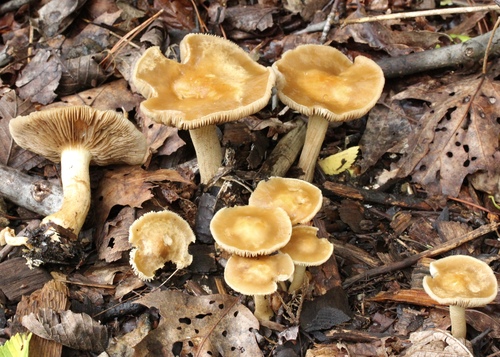
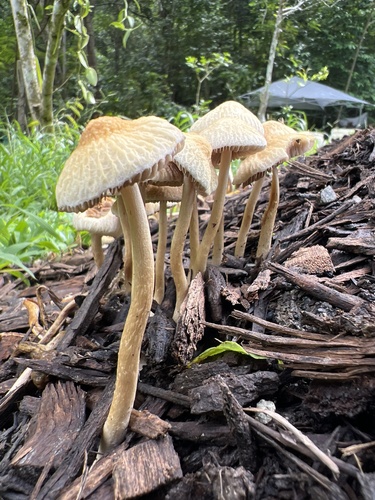
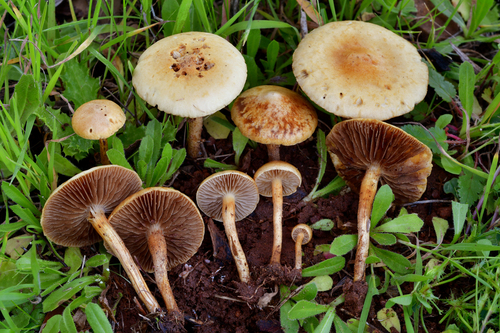
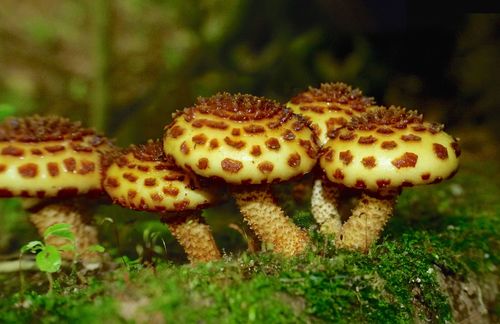
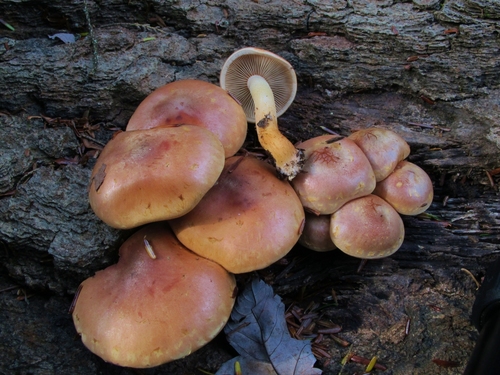
The cap of Hypholoma lateritium measures 3.5–9 centimetres (1+1⁄2–3+1⁄2 inches) in diameter. It is usually brick-red in the center with a paler margin, and has a smooth surface. Sometimes the cap center bears red-brown flecks, and flaky veil remnants may be present on the outer cap surface; these remnants are easily washed off by rain. The gills are crowded. They start yellowish and turn grayish as the fungus ages, and do not have the green color seen in the related species Hypholoma fasciculare. The stipe can grow up to 12 cm (4+3⁄4 inches) long. It is light yellow in color, and darker toward its base. The spore print of Hypholoma lateritium is purple-brown. The spores are ellipsoid, smooth, and thin-walled, with dimensions of 6.0–7.5 × 3.5–4.0 μm, and each spore has a germ pore. Pleurocystidia are abundant; they are fusoid-ventricose to mucronate, and reach up to 40 x 10 µm in size. Cheilocystidia are fusoid-ventricose, cylindric or irregular, with subcapitate apices; they are hyaline and thin-walled, and grow up to 35 x 8 µm. In terms of distribution and habitat, this fungus grows in dense clusters on stumps and roots in Pennsylvania, New Jersey, and West Virginia. It can be found from October through a long period after frosts occur.