About Hypholoma fasciculare (Huds.) P.Kumm.
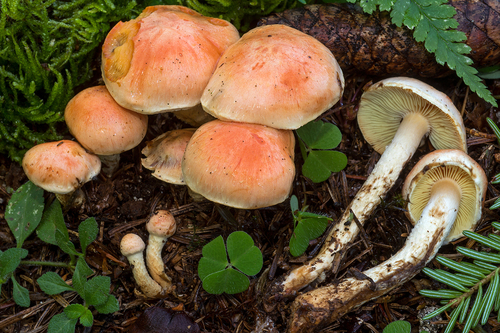
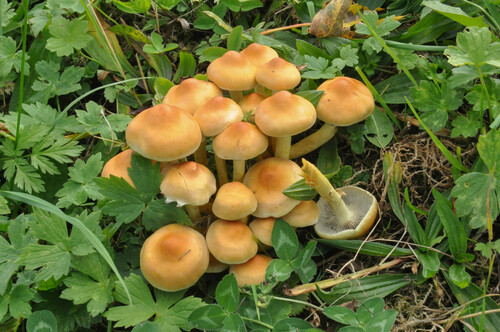
Hypholoma fasciculare, commonly known as sulfur tuft, has a hemispherical cap 2 to 8 cm in diameter. The cap is smooth, sulphur yellow with an orange-brown center and whitish margin. Its crowded gills start yellow, and darken to a distinct green as blackish spores develop in the mushroom’s yellow flesh. It produces a purple-brown spore print. The stipe is 3 to 12 cm tall and 3 to 10 mm wide; it is light yellow with an orange-brown lower section, and often has an indistinct ring zone darkened by spores. This mushroom has a very bitter taste. Under magnification, its spores are purple-black, egg-shaped, and measure 6–8 × 3.5–5 μm. Hypholoma fasciculare grows abundantly on dead wood from both deciduous and coniferous trees, and occurs more commonly on decaying deciduous wood, which has lower lignin content than coniferous wood. It is widespread and abundant across northern Europe and North America, and has also been recorded in Iran and eastern Anatolia, Turkey. It can fruit anytime from spring to autumn. The toxicity of sulfur tuft is at least partially attributed to the toxic steroids fasciculol E and fasciculol F, which act as calmodulin inhibitors. Intraperitoneal LD50 values for these compounds in mice are 50 mg/kg for fasciculol E and 168 mg/kg for fasciculol F. In humans, poisoning symptoms may be delayed 5–10 hours after consumption, and can include diarrhea, nausea, vomiting, proteinuria, and collapse. Cases of paralysis and impaired vision have also been recorded. Most symptoms resolve within a few days. One recorded fatality showed autopsy findings of fulminant hepatitis similar to amatoxin poisoning, alongside kidney and myocardium involvement. However, the mushroom was eaten mixed with other species, so the death cannot be definitely attributed to sulfur tuft. Hypholoma fasciculare has been used successfully in experimental forestry treatments, where it competitively displaces Armillaria root rot, a common fungal disease of conifers, in managed coniferous forests. Extracts of this mushroom have been found to have anticoagulant effects.