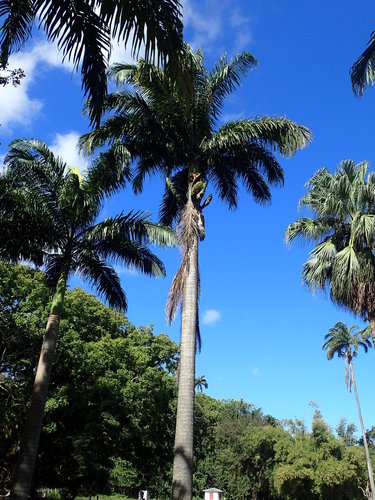
About Hyphaene thebaica (L.) Mart.
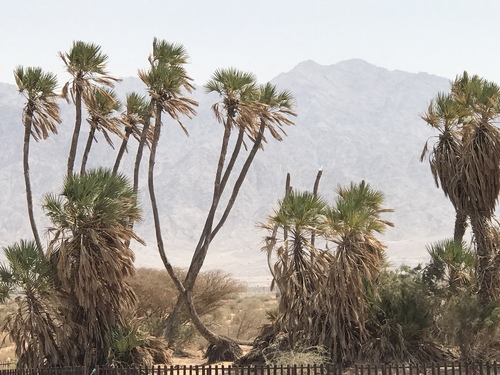
Hyphaene thebaica, commonly called the doum palm, is a dioecious palm species that can grow up to 17 m (56 ft) high. Its trunk reaches a maximum girth of 90 cm (35 in), branches dichotomously, and bears tufts of large leaves at the ends of its branches. The bark is fairly smooth, dark grey, and marked with scars from fallen leaves. The petioles, or leaf stalks, are roughly one metre long, sheathe the branch at their base, and are lined with stout, upward-curving claws. The leaves are fan-shaped, and measure approximately 120 by 180 cm (47 by 71 in). Male and female flowers grow on separate individual doum palm trees. The inflorescences of both sexes have a similar general appearance, reaching up to around 1.2 m (3 ft 11 in) long, branching irregularly, and producing two or three spikes from each branchlet. Female trees bear large woody fruits, each containing a single seed, which stay on the tree for a long period of time. The doum palm is native to the northern half of Africa. It is widespread across the Sahel, growing from Mauritania and Senegal in the west, through Central Africa, and eastward to Egypt, Kenya, Somalia, and Tanzania. It typically grows in areas with accessible groundwater, and is found along the Nile River in Egypt and Sudan, in riverine areas of northwestern Kenya, and along the Niger River in West Africa. It is also native to the Levant and the Arabian Peninsula, including Palestine, Sinai, Yemen, and Saudi Arabia, and is reported to be naturalized in the Netherlands Antilles in the Caribbean. It grows in wadis and at oases, but sometimes grows away from water and on rocky hillsides. It cannot tolerate waterlogged soils, and is highly resistant to damage from bushfires. The doum palm thrives in hot dry regions where few other plants grow, and is valued for the shade it provides. All parts of the tree are usable, but the most important product is its leaves. People living along the Niger and Nile Rivers use the leaf fibre and leaflets to weave baskets (including baskets made as part of the material culture of the Manasir people), as well as mats, coarse textiles, brooms, ropes, string, and thatch. The timber is used for posts and poles, furniture manufacturing, and beehives, and the tree provides wood for fuel. Leaf stalks are used for fencing, and their fibre is used for textiles. Other products made from the tree include fishing rafts, brooms, hammocks, carpets, buttons, and beads. The edible fruit of the doum palm, called doum palm fruit-dates, have different local names across their range. In Eritrea, the tree is called Akat or Akaat in the Tigre language. In the Diu, Una, and Saurashtra regions of Gujarat, India, the tree is known as the Hoka Tree, and its red ripe edible fruit is called Hoka. Among the Hausa people of northern Nigeria, the tree is called Goruba. The thin dried brown rind of the fruit is processed into molasses, cakes, and sweetmeats. Unripe kernels of the fruit are edible, and the shoots of germinated doum palm seeds are also eaten as a vegetable. In Egypt, the fruit is sold by street snack vendors and in herbalist shops. It is popular with children, who gnaw its sweet yet sour hard fibrous flesh located beneath the shiny hard outer crust. Occasionally, the fruit pulp is roasted with sugar and made into a cold summer drink, prepared similarly to how carob drink is made in Egypt. In south-eastern Niger, the fruit pulp is called bri, and it is used as a seasoning to make a traditional well-known millet pancake called massan bri. A commercial drink made from this fruit in Niger, called Torridité Glacée, has a taste somewhat similar to iced coffee or milk chocolate. In addition to eating the fruit, juice is extracted from young doum palm fruit, and palm wine is made from the tree's sap.