About Hypericum undulatum Schousb. ex Willd.
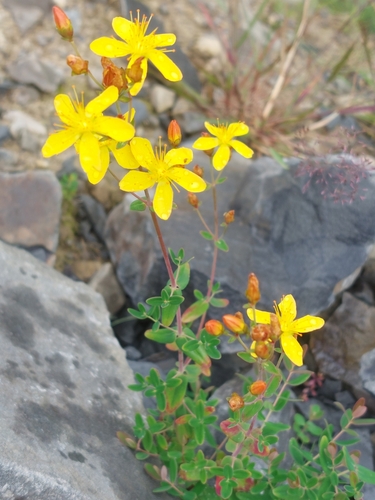
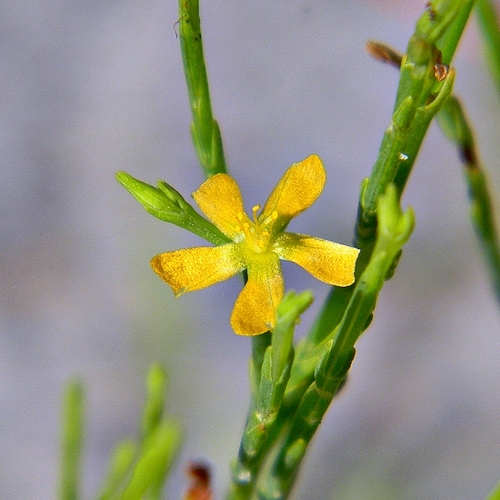
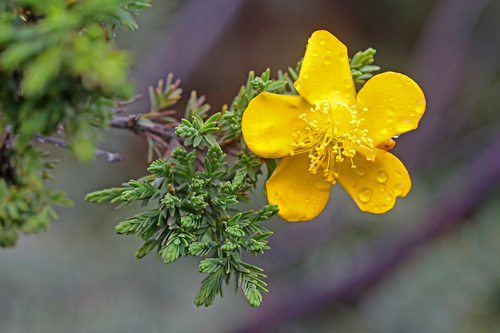
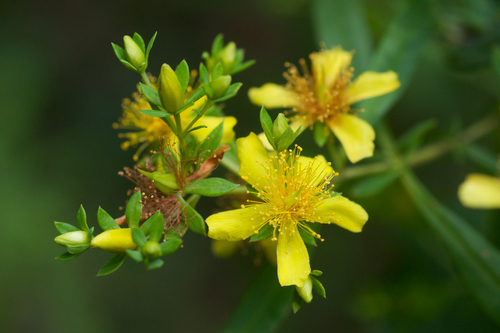
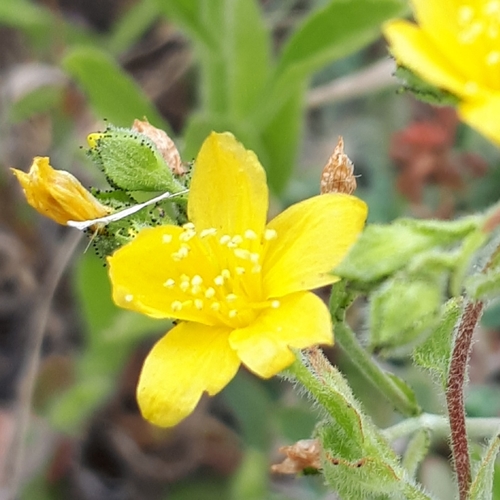
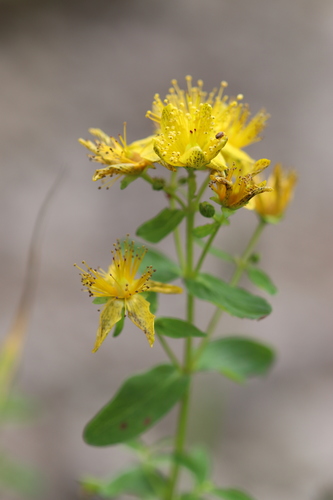
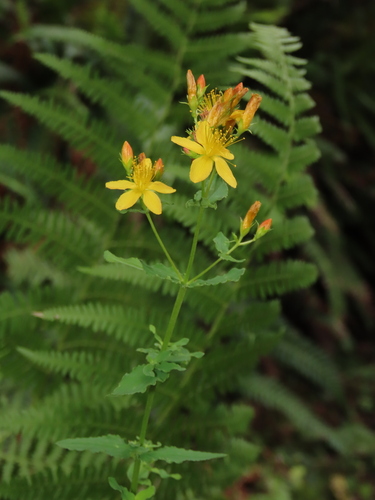
Hypericum undulatum Schousb. ex Willd. grows 1.5–12 cm (0.59–4.72 in) tall, and is typically erect or decumbent with a creeping or rooting base. This herb usually has few to many narrow stems, each with four wings of tissue that hold black glands. Its internodes are longer than the leaves, measuring 12–65 mm (0.47–2.56 in) long. The sessile leaves have elliptic to narrowly oblong blades 6–40 mm (0.24–1.57 in) long and 7–14 mm (0.28–0.55 in) wide. The leaf apex is rounded, the margin is undulate, and the base is rounded or cordate. Leaves have pale undersides and are thinly or thickly chartaceous, with three (occasionally four) pairs of main lateral veins that emerge from the lower quarter of the midrib, plus dense tertiary reticulation. Leaves also have pale, dense laminar glands, and black, closely spaced intramarginal glands that are irregular in size. The inflorescence can hold up to forty flowers, arises from one to three nodes, and has ascending or horizontal flowering branches that come from up to six nodes. The lax inflorescence is mostly cylindrical to subcorymbiform. Pedicels are 1–2.5 mm (0.039–0.098 in) long, while the lanceolate, entire bracts and bracteoles are 2–4 mm (0.079–0.157 in) long. The star-shaped flowers are 12–17 mm (0.47–0.67 in) wide, and are ellipsoid and obtuse when in bud. The five unequal sepals are 3–5.5 mm (0.12–0.22 in) long and 1–1.8 mm (0.039–0.071 in) wide, and remain erect in bud and fruit. Each sepal has five to seven veins and six to twenty black punctiform laminar glands. The five bright yellow petals of each flower are tinged red on the dorsal side, are 7–10 mm (0.28–0.39 in) long and 3–4 mm (0.12–0.16 in) wide (usually about twice the length of the sepals), are obovate to oblanceolate, and bear a small number of punctiform laminar glands. Each flower has 25 to 40 stamens, the longest of which measure 5–8 mm (0.20–0.31 in). The trilocular, ovoid ovaries are 2–3.5 mm (0.079–0.138 in) long and 1–1.5 mm (0.039–0.059 in) wide. The ovoid capsules are 5–8 mm (0.20–0.31 in) long and 3.5–4 mm (0.14–0.16 in) wide. The cylindrical, yellow-brown seeds are 0.6–0.8 mm (0.024–0.031 in) long. This plant flowers in August and September, and its seeds germinate in the spring. Hypericum undulatum grows in non-calcareous fields, marshes, stream banks, fens, and acidic bogs at elevations from sea level to 2,700 m (8,900 ft). It prefers wet areas with lateral water movement. It is native to far western Europe and northern Africa. In the United Kingdom, it occurs in Cornwall, western Devon, Pembrokeshire, Ceredigion, and Merioneth; in Ireland, it is found in western County Cork. In continental Europe it grows in Brittany, central and western Spain, and Portugal. In Africa it occurs in western Algeria, northern Morocco, Madeira, and the Azores. The variety H. undulatum var. boeticum occurs only in extreme southern Spain, while the autonymic variety H. undulatum var. undulatum occurs across the rest of the species' distribution. Hypericum undulatum typically grows in vegetation dominated by mixtures of Molinia caerulea, Juncus acutiflorus, and Juncus effusus. It also grows alongside a range of other herbs, most commonly Angelica sylvestris, Cirsium palustre, Filipendula ulmaria, Galium palustre, Lotus pedunculatus, Mentha aquatica, and Senecio aquaticus. Population sizes of this herb can vary widely, and populations especially increase after grazing or burning is reinstated at overgrown sites. Local declines of H. undulatum are mostly caused by habitat loss from agricultural intensification. To maintain populations of this herb in grasslands, managers should graze sites in the summer and occasionally burn them in the winter.