About Hypericum punctatum Lam.
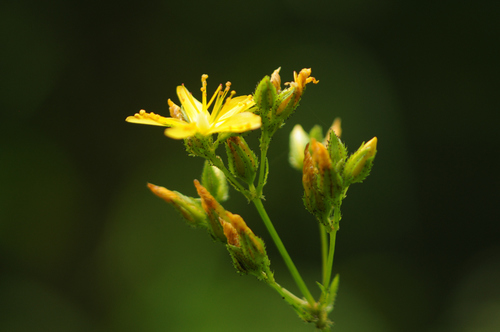
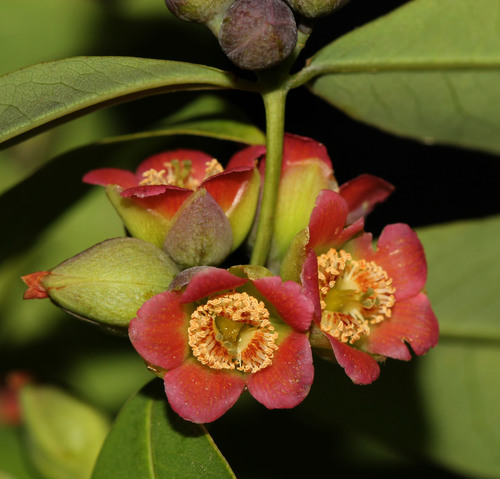
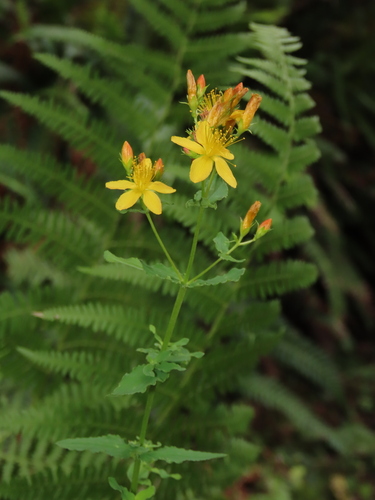
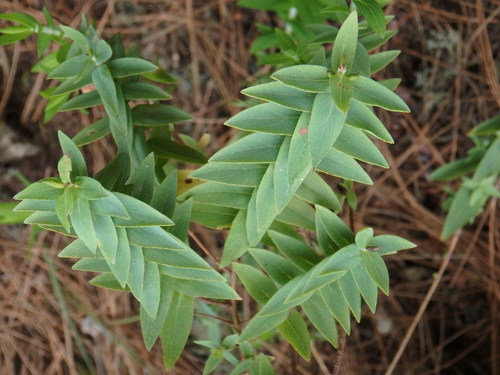
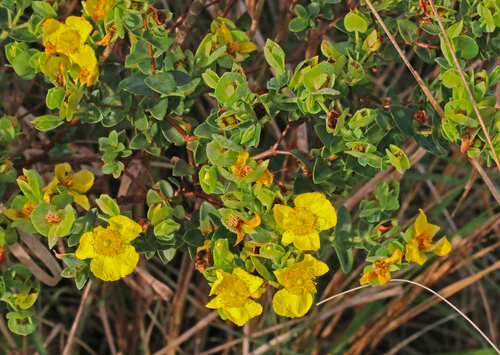
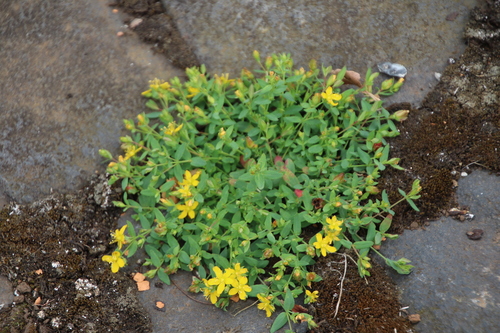
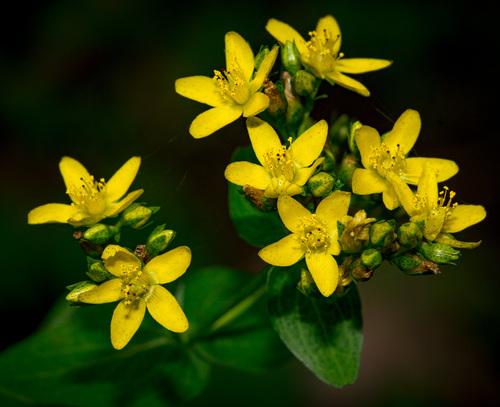
Hypericum punctatum Lam. is an herb that rarely branches and grows 50–100 cm (20–39 inches) tall. It produces one to several reddish, spotted stems that are woody especially near the base, terete, and old stems typically stay through following growing seasons. Stems grow from a curved or twisted root crown. Its root system has a branching taproot and several short rhizomes that allow the herb to grow vegetative colonies. Leaves are 2–6 cm (0.79–2.36 inches) long, arranged oppositely on the glabrous stem, and are either sessile or have very short petioles. Leaf shape ranges from oblong to elliptic or ovate, with rounded apexes and bases that taper toward the stem. The inflorescence is made up of a corymbiform cluster of terminal cymes crowded with many yellow flowers that measure 0.8–1.5 cm (0.31–0.59 inches) across. Flowers are star-shaped and have five petals. Both sepals and petals have dark spots, especially on their undersides; petals are roughly twice as long as the oblong, acute sepals. Petals have dichotomous veining and black bands between the veins. Each flower holds twenty or more stamens, arranged in three main groups, with varying filament lengths. Both stamens and filaments are yellow, though filaments can occasionally turn purple as they age. In the center of the flower sits a flask-like pistil, surrounded by many yellow anthers. Anthers are around 0.5 mm (0.020 inches) in diameter, with divergent yellow thecae and a purplish black connective. The sessile, ovate pistil is 1.3–4 mm (0.051–0.157 inches) long, with three carpels, three locules, and is covered in elongate oil vesicles. Its three styles are about half the length of the ovary, and stigmas are capitate. The fruit capsule is ovoid and 0.4–0.6 cm (0.16–0.24 inches) long. H. punctatum has previously been confused with H. pseudomaculatum, but the two species can be told apart by style length and anther gland color: anther glands are black in H. punctatum and translucent or amber in H. pseudomaculatum. H. punctatum also resembles Hypericum perforatum, but the distinct corymb and heavily dotted petals of H. punctatum separate the two species. This herb flowers from July to August, and fruits from early September to October. Microsporogenesis in H. punctatum has multiple abnormalities. Instead of pairing at diakinesis, chromosomes link together in a chain. During the first metaphase, chromosomes tend to separate, with alternate members moving to opposite poles. Irregularities often result in the haploid chromosome number being seven or nine at second metaphase, rather than the species' usual eight. During the first division, chromosomes may lag and be lost from the spindle apparatus. Extra nuclei occasionally form during meiosis. During the second division, extra chromosomes tend to form their own spindle apparatus and divide. Megasporogenesis shares the same abnormalities: it also has a tendency to form chromosome chains, and displays the same pattern of alternating chromosome movement during the first metaphase. H. punctatum is common in floodplains, roadsides, moist fields, and thickets, and prefers growing at altitudes between 50–1,200 m (160–3,940 feet). It occurs throughout the American Midwest and Atlantic coast, and extends into Canada in Nova Scotia, Ontario, and Quebec. It also grows wild in Sweden. Ecologically, this herb is valuable to bees, and attracts many types including the American bumblebee and sweat bees. Beetles and hoverflies also visit its flowers, though they pollinate to a lesser degree. The flowers do not produce nectar, so insects are attracted by the pollen instead. Gray hairstreak caterpillars feed on the seed capsules, and gray half-spot caterpillars feed on the leaves. While many insects eat this plant, foraging mammals rarely consume its foliage, because leaves contain hypericin which can blister mammalian skin and irritate the digestive tract.