About Hypericum perforatum L.
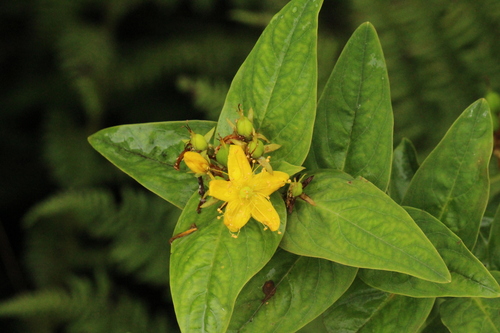
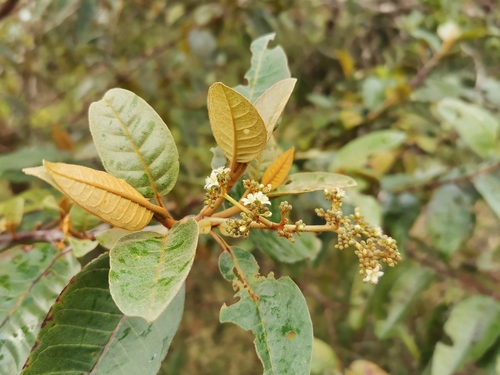
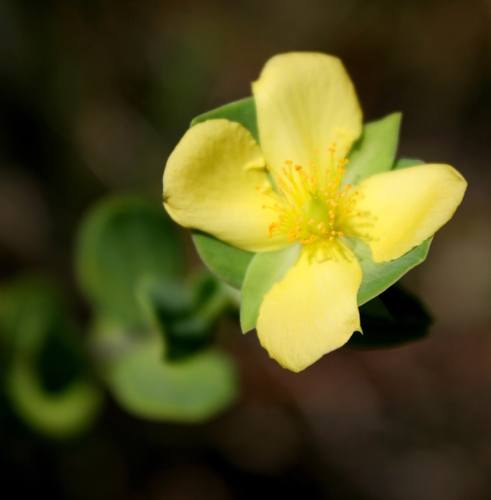
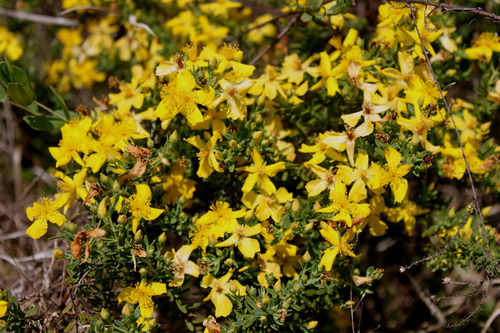
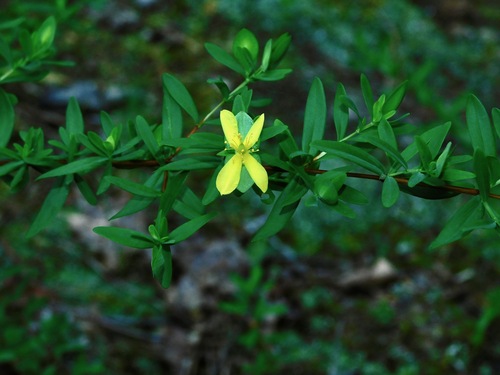
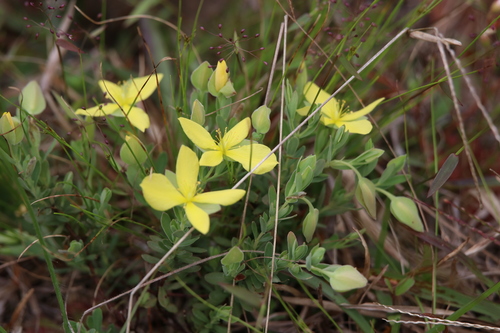
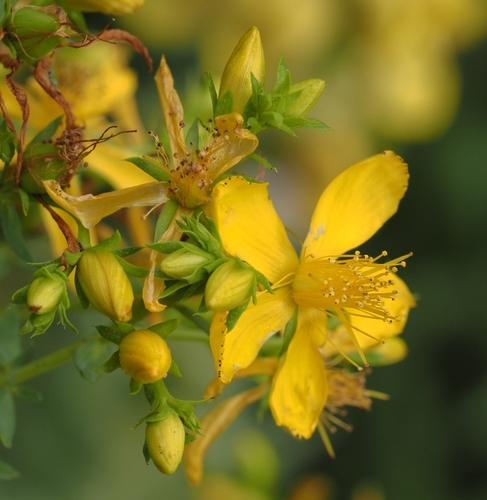
Hypericum perforatum L. is a glabrous herbaceous perennial plant. Each plant has a slender woody taproot with numerous small fibrous lateral roots, extensive creeping rhizomes, and a woody root crown. The taproot grows 0.6–1.5 metres deep into soil, depending on growing conditions. Stems are erect, branched in the upper section, and typically reach 0.3 to 1 metre in height. They are woody near the base, develop segmented joint-like appearances from leaf scarring after leaf drop, range in color from rusty-yellow to rosy, have two distinct edges, and usually shed bark near the base. Stems persist through winter and produce new growth with flower buds the following year; no flowers form on first-year growth. Leaves are sessile, growing opposite one another on stems, and can take multiple shapes: linear (very narrow, almost grass-like), elliptic (rounded oval, slightly wider at the base with a blunt or indistinct tip), or oblanceolate (narrow, widest toward the leaf tip, still long and narrow). Main leaves measure 0.8 to 3.5 centimetres long and 0.31 to 1.6 centimetres wide. Leaves growing on branches subtend the plant’s shortened branchlets. Leaf color is yellow-green, with scattered translucent dots of glandular tissue that are clearly visible when leaves are held up to light, giving the foliage a perforated appearance. Leaf margins usually bear scattered black dots (called dark glands), though these dark glands may sometimes occur away from margins. The plant has a faint aromatic odor that resembles resinous balsam, and a bitter, acrid taste. Its showy, conspicuous flowers measure 1.5–2.5 cm across, are bright yellow, and have black dots along petal edges. Most flowers have five large petals and five smaller leaf-like sepals below the petals. Sepals are around 4–5 mm long, green, lanceolate (spear-head shaped) with a pointed tip, and have the same mix of clear and black glands found on leaves. Petals are much longer, 8–12 mm, oblong shaped, and completely cover the sepals when viewed from the front of the flower. The many bright yellow stamens are joined at the base into three bundles. Stamen filaments vary in length and extend outward in all directions from the flower’s center. Pollen grains range from pale brown to orange in color. Each flowering stem holds between 25 and 100 flowers and is heavily leafy. The fruit is a 7–8 mm long capsule that holds seeds in three separate valved chambers. Seeds removed from the capsule have a much higher germination rate, as the capsule itself contains an inhibiting factor. Seeds are black, lustrous, rough-textured, netted with coarse grooves, around 1 mm in size, and an individual plant produces an average of 15,000 to 34,000 seeds. Hypericum perforatum is thought to be native to every European nation, only absent from far northern regions such as northern European Russia and Svalbard. It grows in parts of North Africa, where it is native to Morocco, Algeria, Tunisia, and Sudan. On the Arabian Peninsula it only grows in parts of Saudi Arabia. It is native to the entire Western Asia phytogeographic region, extending from the Aegean Islands and Turkey, through Israel and Palestine in the west, to Afghanistan in the east, and is only absent from the Sinai Peninsula. Just east of this region, it is also native to Pakistan and the western Himalaya region of India. In temperate Asia, it is mostly absent from Siberia except for Western Siberia, the Altai Region, and the warmest parts of Krasnoyarsk Krai, and has been introduced to Irkutsk and Buryatia. It is native to the flora of Central Asia, growing in all former Soviet Central Asian republics, and is found across nearly all parts of the Caucasus. In China it is native to Xinjiang (western China), central China, and southern China, but is not native to Inner Mongolia, Manchuria, or Tibet. In far eastern Asia it has been introduced to Primorye (Russia), Korea, and Japan. In North America, it is present in all continental United States states except Utah, Arizona, Florida, and Alabama, and has been introduced across most of Canada, as well as to Hawaii, Cuba, and Haiti. In South America, it occurs in Argentina, Chile, Uruguay, the Juan Fernández Islands, and the more temperate southeastern parts of Brazil. In southern Africa it has become established in South Africa, Lesotho, and Réunion. In Australia it is found in South Australia, Tasmania, Victoria, New South Wales, and Western Australia, and it has been introduced to both the North and South Islands of New Zealand. This species grows in a wide variety of habitats including open woods, meadows, grasslands, steppe, riverbanks, stony or grassy hillsides, and roadsides. It prefers dry habitats or areas with strong drainage. It thrives in areas with at least 760 mm of annual rainfall. Its distribution is restricted by temperatures too low to support seed germination or seedling survival: it requires an absolute minimum temperature of −3 °C or an annual average temperature of 9 °C. Additional limiting factors for its range are altitudes greater than 1,500 m, annual rainfall less than 500 mm, and daily mean temperatures greater than 24 °C. St John's wort reproduces both vegetatively and sexually, and adjusts its growth pattern to promote survival based on environmental and climatic conditions and its own age. Summer rains are particularly effective at supporting vegetative regrowth after the plant has been defoliated by insects or grazing. It can also produce viable seeds without fertilization. Its seeds can remain dormant underground in a soil seed bank for decades, and germinate after soil disturbance. Hypericum perforatum is toxic to many domestic animals including cows, sheep, and horses. When these animals graze on the plant, they develop severe poisoning symptoms. Initial signs include reddening and swelling of the skin, followed by skin necrosis and sloughing. Non-pigmented white skin is most affected, such as the nose and ears of certain sheep breeds. Young animals are more susceptible to poisoning. The plant is most toxic in spring, when it is most palatable to herbivores, and it retains its toxic effects after being dried into hay. Affected animals become highly photosensitive, and sunlight exposure worsens their symptoms, so affected animals should be moved to a dark area; antihistamines or anti-inflammatory drugs may help relieve symptoms. When Hypericum perforatum products are used alongside other antidepressants, they can cause adverse effects by increasing brain serotonin levels, leading to a potentially life-threatening condition called serotonin syndrome, which is associated with rapid heart rate, acute hypertension, mydriasis, and fever. Other possible adverse effects include photosensitivity, acute neuropathy after sun exposure, and reduced response to chemotherapy. Common side effects of St John's wort products include headache, nausea, fatigue, dry mouth, sleepiness, and gastrointestinal upset. It should not be consumed during pregnancy or breastfeeding. Although Hypericum perforatum is generally avoided by mammalian herbivores, a number of insect species rely on it and its close relatives as a food source. Two beetle species, Chrysolina quadrigemina and Chrysolina hyperici, feed on Hypericum plants including H. perforatum. Chrysolina quadrigemina may be metallic blue, purple, green, or bronze, and is better adapted to warm, dry climates. Chrysolina hyperici is consistently smaller, metallic green, and tends to grow in wetter, cooler regions. Another Hypericum-specialist beetle is Agrilus hyperici, the St John's wort root borer: its larvae feed on H. perforatum roots, while adults feed on its foliage. The caterpillar of the moth Aplocera plagiata, commonly called the common St John's wort inchworm, feeds heavily on H. perforatum leaves; adults are small moths with gray wings marked by dark gray bands. Another moth that feeds on H. perforatum is Euspilapteryx auroguttella: its caterpillars first mine the inside of leaves, then roll leaves into cigar shapes to feed more safely. Agonopterix hypericella is another small (17 mm) gray moth that feeds exclusively on Hypericum. Zeuxidiplosis giardi, the common St. Johnswort gall midge, is a small (3 mm) fly that eats H. perforatum during its development. Larvae feed on leaf buds, which triggers the plant to form a round gall where the developing insect can feed, stay protected, and pupate into a mature adult. Common St. John's wort has been used in herbalism for centuries. It was used in classical antiquity, and was a standard ingredient in ancient medicinal concoctions called theriacs, ranging from the Mithridate included in Aulus Cornelius Celsus' De Medicina (c. 30 CE) to the 1686 Venice treacle held by d'Amsterdammer Apotheek. One folk preparation is an oily extract called St John's oil, a red oily liquid extracted from H. perforatum that may have been used to treat wounds by the Knights Hospitaller, the Order of St John. Crushed dried flowers of the plant are used to make the herbal preparation herba hyperici.