About Hypericum olympicum L.
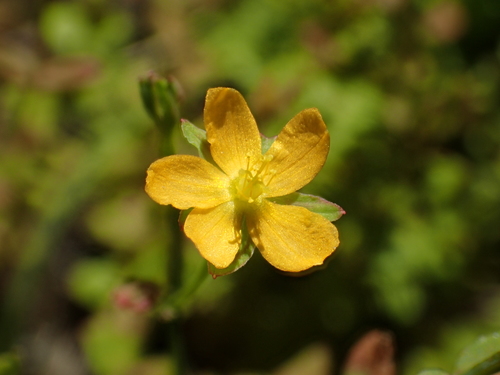
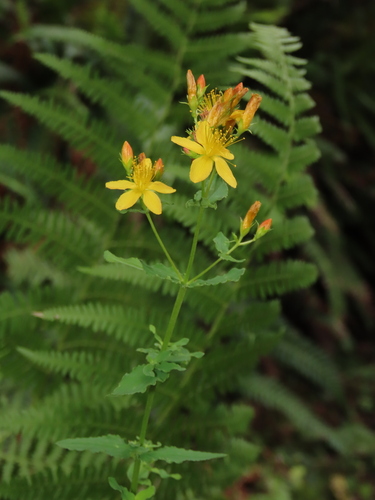
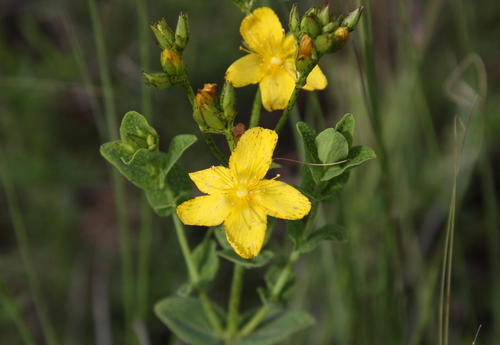
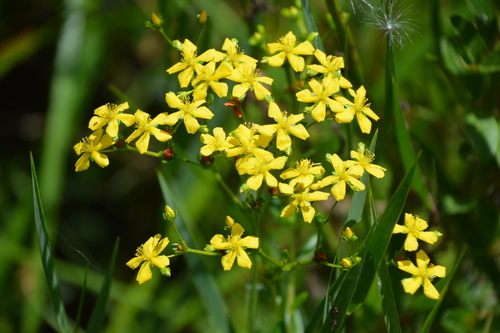
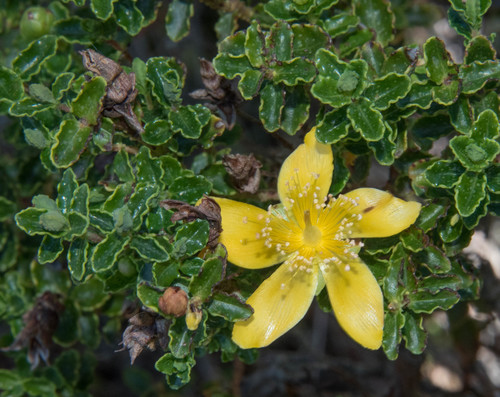
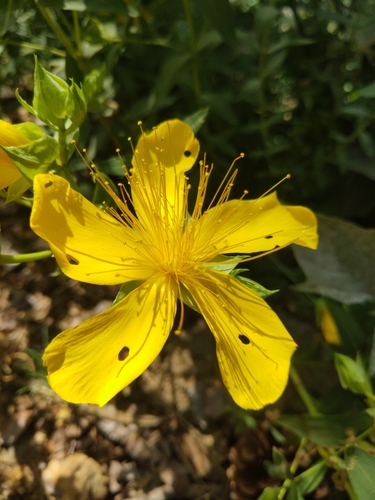
Hypericum olympicum L. is a species of flowering shrub or subshrub that reaches 0.1–0.55 metres (0.33–1.80 ft) in height. It grows in an erect to decumbent habit, and very rarely grows prostrate. It forms caespitose clumps with few to numerous stems, is occasionally rooting, and remains unbranched below its flower clusters. Stem internodes measure 5–15 millimetres (0.20–0.59 in) long, and can be either shorter or longer than the plant’s leaves. Leaves grow spreading to erect, are more or less glaucous, and measure 5–30 by 2–12 millimetres (0.197 in–1.181 in × 0.079 in–0.472 in). Leaves are typically elliptic, rarely lanceolate-elliptic, concolorous, and thinly coriaceous, with an apex that ranges from acute to subacute or rounded-obtuse, and a rounded or cuneate base. Leaves have 0 to 3 pairs of visible unbranched lateral veins. Laminar leaf glands are pale and not prominent, while small, black intramarginal glands are present in small numbers. Plants usually produce 1 to 5 flowers, but can grow up to nine flowers from up to three nodes, rarely from one lower node. Flower pedicels are 2–4 millimetres (0.079–0.157 in) long and rather stout. Bracts are reduced-foliar, broadly imbricate, and lack black glands; bracteoles are similar in form but smaller. Open flowers are 30–65 millimetres (1.2–2.6 in) in diameter, with ovoid-pyramidal, rounded buds. Sepals are either unequal or subequal, broadly imbricate, and paler than leaves, measuring 6–16 by 3–12 millimetres (0.24 in–0.63 in × 0.12 in–0.47 in). Sepals are broadly ovate to lanceolate with a rounded base, are entire, large, pointed, and persist when the plant forms fruit. They have 9–15 branching veins; laminar sepal glands are pale and linear, and occasionally a small number of black punctiform glands may be present. Marginal glands are normally absent, but very rarely one or two black apical glands may occur. Petals are golden or pale yellow, sometimes with red tinges or red lines, measuring 15–30 by 8–12 millimetres (0.59 in–1.18 in × 0.31 in–0.47 in). There are roughly twice as many petals as sepals; petals are rounded with a short apiculus, and have an apex that ranges from acute to obtuse. Laminar petal glands are pale and linear, while 1 to around 7 black marginal glands may be present, or marginal glands may be absent entirely. There are approximately 65–125 stamens (around 0.9 times the number of sepals) that measure 14–25 millimetres (0.55–0.98 in) long. Ovaries measure 3 by 2.5 millimetres (0.118 in × 0.098 in) and are broadly ovoid; styles measure 18–23 millimetres (0.71–0.91 in) and are six to eight times the length of the ovary. The seed capsule measures 5–10 by 4–8 millimetres (0.20 in–0.39 in × 0.16 in–0.31 in), is shorter than the sepals, and has a shape ranging from broadly ovoid to spherical. Seeds are dark brown, around 1.8 millimetres (0.071 in) long, and have a shallowly patterned testa. This species is native to Southeastern Serbia, Macedonia, Albania, Bulgaria, Greece (excluding Crete and the western Aegean islands), and northwestern Turkey. It was first introduced to England in 1676 by Sir George Wheeler from seeds collected in Turkey, and was cultivated at the Oxford Botanical Garden. It has also become established in Belgium and France, where it is classified as an invasive species. It grows in sandy, stony, sometimes grassy areas, among rocks in open ground, or in pine woodland, at elevations ranging from 0 to 2,000 m (6,600 ft). Because of its large, showy flowers, relative hardiness, and dense growth habit, H. olympicum is valued by gardeners, particularly in the United Kingdom. It has won several horticultural awards; in 1930, it was awarded the Royal Horticultural Society's Award of Garden Merit under the incorrect name H. fragile. While it is not harmful to humans, it can be toxic to dogs, cats, and horses, so it should be planted away from areas accessible to these animals. It can be grown in chalk, clay, sand, or loam, and requires moist soil with sharp drainage. Because of its need for sharp drainage to prevent winter rot, it is well suited for rockeries or alpine gardens. It tolerates a soil pH between 6.1 and 7.8, meaning it can grow in both mildly acidic and mildly alkaline conditions. The plant usually takes 5–10 years to reach its full height, but reaches maturity much faster. It should be planted in May or June, flowers from June to August, and cuttings for propagation are taken from May to July. H. olympicum f. olympicum is used alongside other Hypericum species in parts of rural Turkey as traditional folk medicine. Its flowers are typically harvested and used to treat stomach aches, cuts, and burns.