About Hypericum mutilum L.
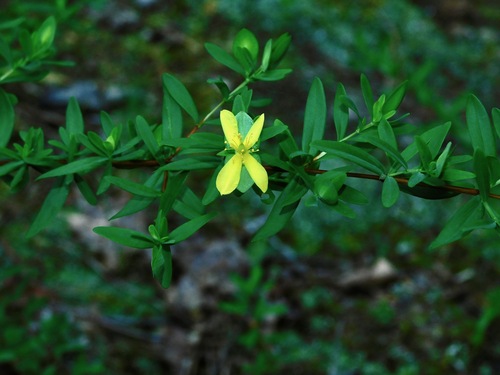
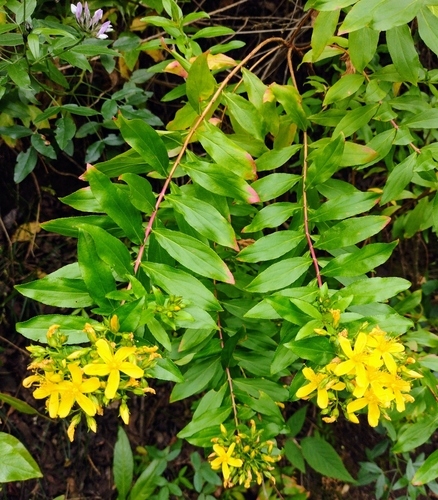
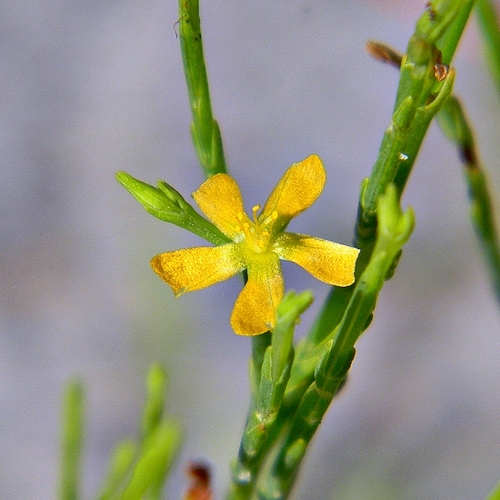
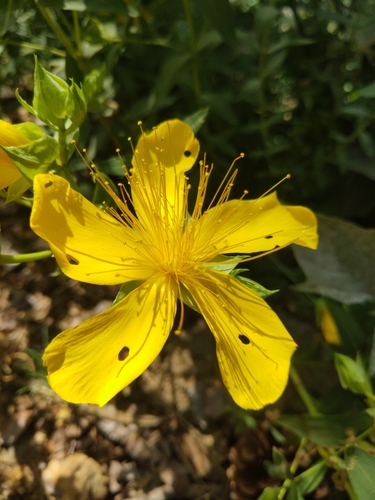
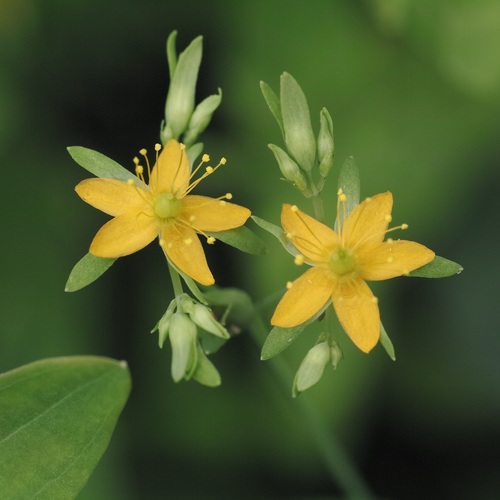
Hypericum mutilum L. is a glabrous herb that can be annual or perennial, growing in an erect or decumbent form, with a height between 15–60 cm (5.9–23.6 in). Its fibrous roots grow from a rhizome or the base of the stem. Stems are either solitary or branched at the base, and typically bear ten pairs of spreading branches. The stems are green, four-angled, more or less flattened and two-edged in their upper sections, and have smooth lines. Internodes measure 10–40 mm (0.39–1.57 in) long, and are longer than all leaves except for some of the uppermost ones. Its sessile, spreading, persistent leaves measure 5–27 mm (0.20–1.06 in) long and 1–15 mm (0.039–0.591 in) wide. Leaves have a papery, membranous texture. Lower leaves are shaped ovate or elliptic, while upper leaves are ovate or nearly circular. Leaves are flat, with a prominent midrib on their lower surface. The leaf apex is rounded to obtuse, and the leaf base is rounded, or rarely wedge-shaped. Leaves have three to five basal veins with somewhat noticeable ascending branches, and loose, unclear tertiary vein reticulation. Glands on the leaf blade are dense and dot-shaped. Leaf pairs are arranged in a spiral, growing smaller and more crowded moving lower down the stem. The terminal, cylinder-shaped inflorescence holds five to sixty flowers, with regular monochasial or dichasial branching, and flowering branches grow from up to ten nodes below the inflorescence. Pedicels measure 1–3 mm (0.039–0.118 in) long. Upper bract leaves are leaf-like, and bracts range from awl-shaped to leaf-like. The star-shaped flowers are 3–5 mm (0.12–0.20 in) wide, and the central flower of the inflorescence has a shorter pedicel. The sepals are lanceolate to linear-lanceolate, 2–4 mm (0.079–0.157 in) long and 1–1.5 mm (0.039–0.059 in) wide. They can be equal or unequal in size, are acute to pointed at the tip, and have entire margins. Sepals have three to five unbranched veins that are barely prominent. Glands on the sepals are line-shaped, becoming dot-shaped near the distal end. The oblong petals are golden-yellow, 1.75–2.5 mm (0.069–0.098 in) long and 0.8–1.5 mm (0.031–0.059 in) wide, shorter than the sepals. Petals have two or three veins and lack glands. There are five to sixteen stamens, which are rarely grouped, with the longest measuring 1.8–3 mm (0.071–0.118 in). The pistil is 2.5 mm (0.098 in) long and single-chambered. The ovoid to ellipsoid ovary is approximately 1 mm (0.039 in) long and 0.6 mm (0.024 in) wide. The three styles measure 0.5 mm (0.020 in) long, and the stigmas are broadly head-shaped. The ovoid to cylindric-ellipsoid fruit capsule is 2–4 mm (0.079–0.157 in) long and 1.6–2.4 mm (0.063–0.094 in) wide, with a rounded summit. The light brown seeds measure 0.4–0.7 mm (0.016–0.028 in) long. This herb flowers from July to September. Three subspecies are recognized. H. mutilum subsp. mutilum has an apical internode shorter than the other internodes. Its leaves vary in shape, but are most often broadly ovate or suborbicular, and have a pale underside. Its sepals are wider above their middle. The inflorescence of this subspecies branches from two to ten nodes, with branching that is chiefly dichasial. This subspecies occurs across the entire range of the species, except for the species' northernmost regions and part of the Gulf of Mexico coast. H. mutilum subsp. latisepalum has well-developed apical internodes that are longer than its other internodes. Its leaves are broadly ovate with pale undersides. Its sepals are more or less overlapping, and are wider above their middle. The inflorescence branches from one to four nodes, and branches diffusely and monochasially toward its distal end. This subspecies occurs only in scattered populations in low grounds and coastal mud between New Jersey, Florida, and westward to Texas. H. mutilum subsp. boreale has shorter or absent apical internodes. Its broadly ovate to elliptic leaves do not have pale undersides. Its sepals do not overlap, and are wider in their upper half. The inflorescence branches from two to six nodes, with branching that is mostly dichasial. When this subspecies grows submerged in water, plants are almost always sterile and have elongated stems. This subspecies occurs from Newfoundland west to Manitoba, Wisconsin, and Minnesota, and south to Virginia. In terms of habitat and distribution, Hypericum mutilum grows in ditches, marshes, shorelines, and occasionally in moist woods and fields. In the United States, it grows up to 1,400 m (4,600 ft) in elevation, and in Ecuador it grows up to 2,300 m (7,500 ft) in elevation. It prefers a soil pH between 4.8 to 7.2. It is native to Eastern Canada and the United States, ranging north from southeastern Manitoba to southern Ontario to Newfoundland, south to Florida, and west to Texas. It has been introduced to Landes in France, Tuscany in Italy, Silesia in Poland, Mexico (where it may be partially native), Honduras, Ecuador, Peru, Brazil, New Zealand, and Hawaii. Populations discovered in France in 1934 and in Italy in 1834 appear to have been established for a long time. Ecologically, similar to some other species of Trigynobathys, H. mutilum grows in moist or muddy habitats, where its seeds adhere to wading birds. The long-distance migrations of these birds are most likely the method that allowed the species to be introduced to Central and South America, where it appears to have been established for a long time in some areas including Mexico and Ecuador.