About Hypericum coris L.
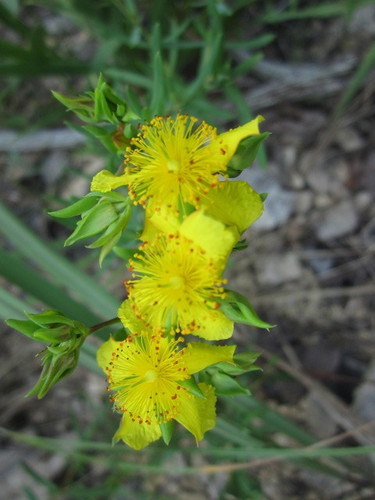
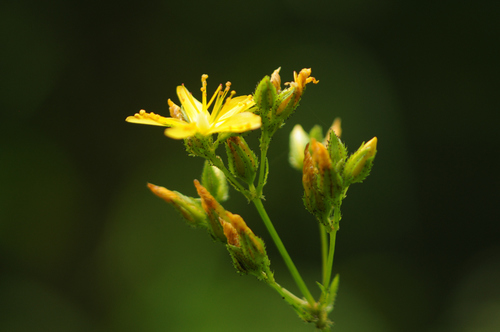
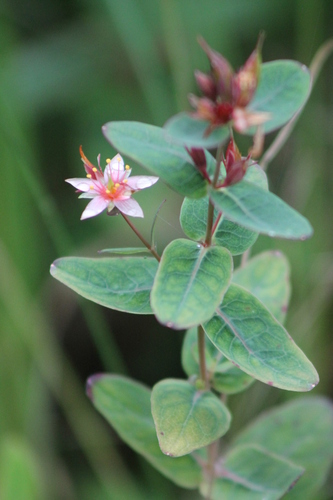
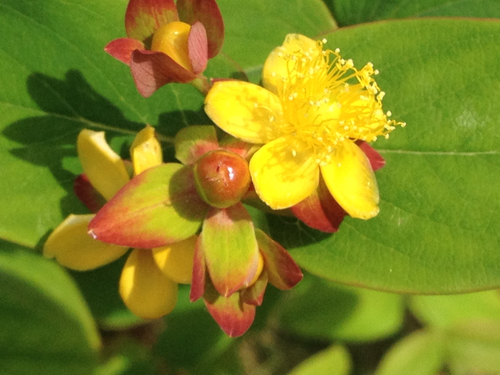
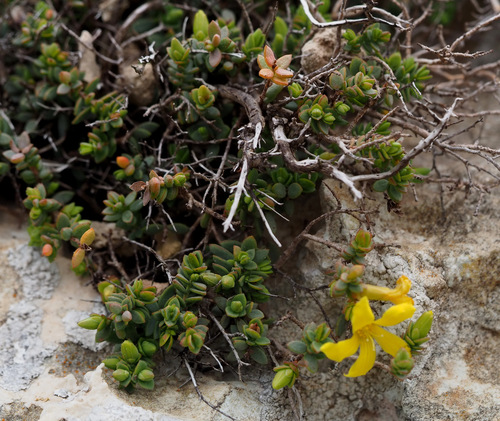
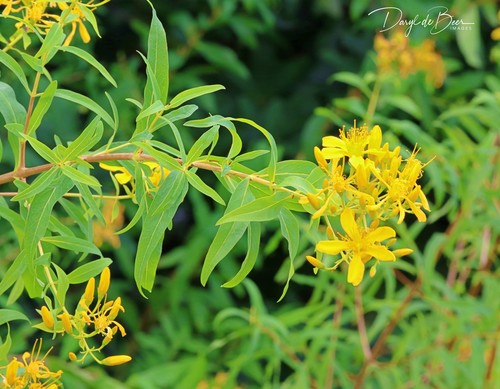
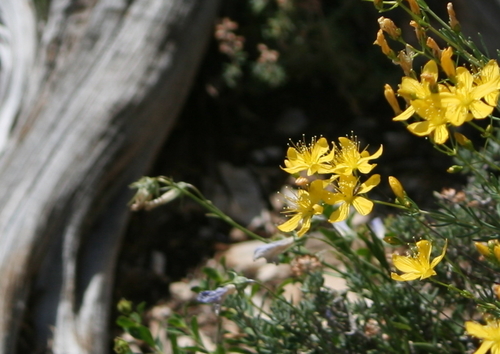
Hypericum coris L. is a low or dwarf shrub that grows 10–40 cm (4–16 in) tall, rooting from a woody, branching base. Its stems are slender, typically 4-lined (occasionally 3-lined), and eglandular. The annual stem rings of this species are much smaller than those of other Hypericum species, marked by porosity. Vessels are arranged in short radial rows, measuring 30–60 micrometers in diameter, and unlike most other species in the genus, they contain dark-staining substances. Internodes are 4–35 mm long, and may be either shorter or longer than the plant’s leaves. Leaves are arranged in whorls of four, and range from sessile to petiolate. The leaf undersides are a dull grayish-green, and leaves measure 4–20 mm by 0.7–2 mm. Leaves are usually linear, with an apex that tapers to a point or is rounded, and they are typically 1-veined. Leaf blade glands are pale, dense, and punctiform, and intramarginal glands are not visible. The plant usually produces 3–20 flowers, but may produce as few as one. Flowers develop from 1–3 nodes, arranged in lax inflorescences that are broadly cylindric, pyramidal, or subcorymbiform. The inflorescence is 15–65 mm long and does not have subsidiary branches. Bracts are smaller than other leaves, while bracteoles are linear to elongated and sparsely fringed with black glands. Individual flowers are 13–20 mm in diameter, with spherical buds. Sepals are usually equal in size, free or nearly free, and not imbricate. They measure roughly 3 mm by 1 mm, are rounded in shape, and have 3 non-prominent veins. Petals are yellow with no red tinge, are persistent, and measure 10 mm by 3 mm. There are three times as many petals as sepals. Petals lack marginal glands, and have pale, narrow laminar glands. There are around thirty stamens, the longest of which reach 7–11 mm long. There are 2 or 3 ovaries, each around 1 mm in length, and three times as many styles (which measure 6–8 mm long) as ovaries. The seed capsule is ovoid, with valves that have narrow vittae and swollen vesicles. Seeds are brown, roughly 1.7 mm long, shaped as curved-cylindric, and covered in fine papillae. This species is native to the western Alpine mountain range. It can be found across Switzerland, northwestern Italy, and extreme southeastern France. It grows in sunny locations among calcareous rocks, at altitudes between 120 meters and 2,000 meters above sea level. Hypericum coris blooms in summer from June to July. It requires full sun and moderate water to grow successfully, and is cultivated as an ornamental plant in some rock gardens.