About Hypericum canadense L.
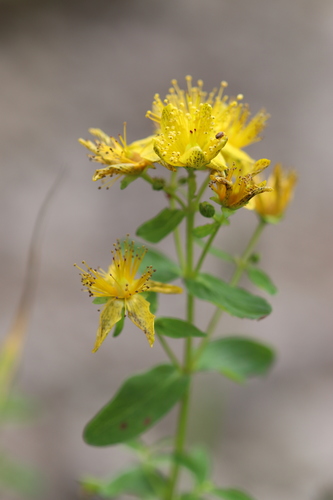
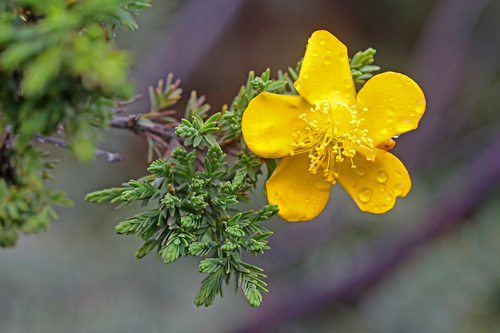
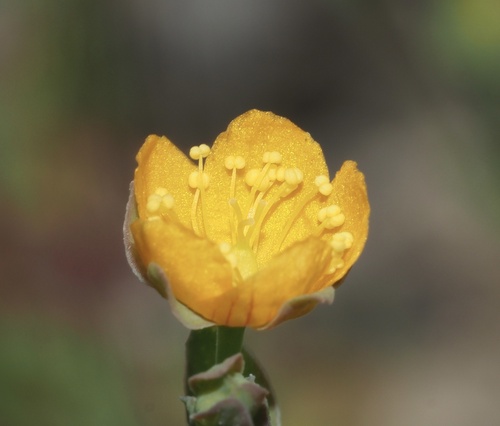
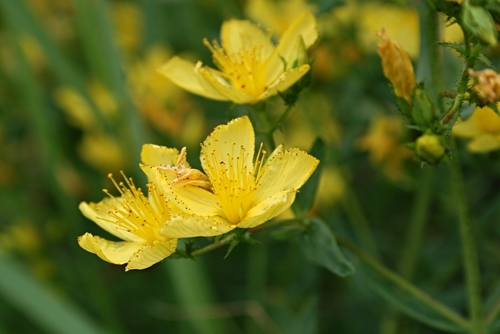
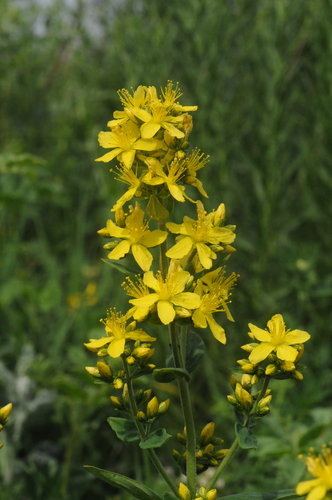
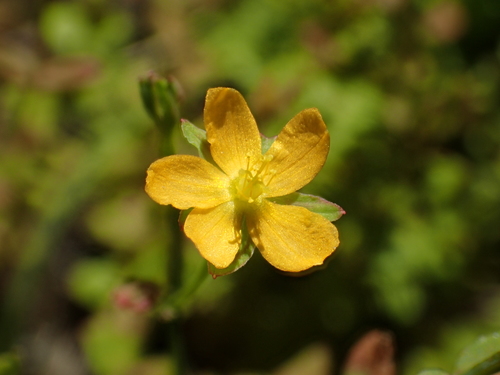
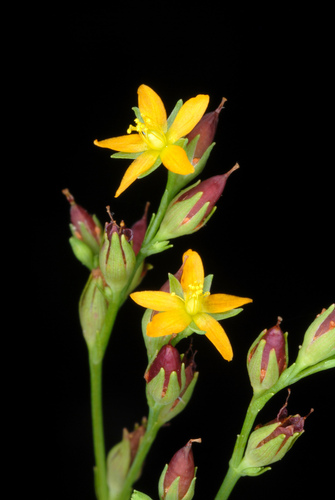
Hypericum canadense L. is a perennial herb that produces short basal offshoots each autumn. Its slender stems, which reach 5–75 cm (2.0–29.5 in) in height, are simple or branched in their upper half, and are four-angled and slightly winged. It has fibrous roots and no rhizomes or stolons. Its leaves have characteristic pellucid dots, are shaped linear to linear-oblanceolate, are rounded at the tip, narrow toward a sessile or subpetiolar base, and measure 1–4 cm (0.4–1.6 in) long and 1–6 mm wide. Leaf pairs are spirally arranged (not decussate); lower leaves become more purplish, smaller, more elliptic, and crowded as internodes shorten. Leaves have one to three main nerves, with weaker secondary veins except near the leaf base. Flowers are solitary or arranged in simple naked cymes that only bear linear bracts; inflorescence branches are divergent and form a somewhat corymbiform shape. The five linear-lanceolate sepals are blunt to slightly pointed, measure 2.5-4.5 mm long and 0.8–1 mm wide, are shortly united at the base, and one sepal is longer than the others. The five-veined yellow petals are oblong to oblanceolate with rounded tips, and are about as long as the sepals or shorter. The fifteen stamens are arranged in three loose fascicles; both filaments and anthers are yellow, and the globose anthers are about 0.25 mm wide. The ovoid, yellow pistil is 2 mm long, with indistinct carpels and one locule, and the three styles are 0.25 mm long. The conical capsule is red or purplish, measures 4–6.5 mm long and 2-2.5 mm wide, and has persistent styles about 0.5 mm long. The light brown, cylindrical seeds have conical or rounded ends and measure 0.6 mm long. This species flowers and fruits from late July to early September, and has a diploid number of 16. This species occurs naturally in eastern Canada and the eastern United States, ranging from Ontario to Newfoundland, south to northern Florida, and west to Iowa. It is considered extirpated from Manitoba. H. canadense was first identified in Europe near Almelo, the Netherlands, in 1935, and previously collected 1909 specimens were later confirmed to be this species. A reported 1959 discovery in France was later determined to be erroneous, as the collected specimens were actually H. majus. H. majus was found in Germany in 1956, and it was likely introduced to both France and Germany by American troops. H. canadense was first discovered in Ireland in 1954, when a single plant was found on the shore of Lough Mask. It was discovered again in Ireland in 1968, 200 km (120 mi) south of Lough Mask in Glengarriff. Irish specimens of H. canadense are more similar to H. canadense var. magninsulare than to the type variety, due to a red line on their petals and an intermediate petal shape between the narrow, pointed shape of the variety and the lanceolate, rounded shape of the type. There are three hypotheses for the presence of H. canadense in Europe. First, it could have been introduced by human activity. This is considered highly improbable: it is unlikely that European gardeners would cultivate the plant, and it is also unlikely that American troops could transport it, even though this hypothesis has been proposed. Second, it could have been transported to Ireland by natural means, most likely carried on the feet of Greenland white-fronted geese, which breed in Greenland and winter in North America or Ireland; this hypothesis can only be confirmed if H. canadense is discovered in Greenland. Third, the species could be a relict in Europe. This hypothesis is supported by the similar geographic distributions of other known relict species. The occurrence of H. canadense in Newfoundland demonstrates its hardiness, suggesting it could have withstood the most recent glaciation, similar to the hardy species Najas flexilis which survived the last glaciation according to fossil evidence. The excavation for the Corrib-Mask Canal lowered water levels in the Irish area where H. canadense grows; if the site had been underwater before the canal was built, the relict hypothesis would be disproven. An 1841 map shows the area where H. canadense grows stops 90–300 yd (82–274 m) short of the lakeshore. However, the plant does grow below an older shore line of uncertain age that is certainly post-glacial, but it may be old enough to allow the plant to have migrated down to its current location. The abundance and conspicuousness of the plant contradicts the relict theory: a few plants were discovered simultaneously in France and Ireland in the 1950s, but the plants are now quite abundant, which suggests more recent naturalization. Most current evidence supports the relict hypothesis, but future spreading or lack of spreading of the species will better clarify whether it is a recent introduction or an established native relict. Hypericum canadense grows in wet or dry soils in sandy ditches, clearings, road verges, pastures, boggy or peaty regions, gravelly beaches, and occasionally in woodlands. In the United States, it is classified as a facultative wetland plant, meaning it usually occurs in wetlands but can also grow in non-wetlands, typically in areas where the soil surface floods at least seasonally. In North Carolina, it occurs at elevations up to 5,000 ft (1,500 m). In the Chicago area, it is a highly conservative species that grows almost exclusively in undisturbed remnant natural areas, primarily high-watertable sand flats and acidic wet to wet-mesic sand prairies. The variety H. canadense var. magninsulare prefers wet soils in pastures or swamps. In Ireland, it grows in wet soils with a pH between 4 and 5 and rich organic matter, and requires base-poor peaty soils to grow. Cattle grazing likely reduces competition and provides open ground for the herb to establish. Hypericum canadense and Hypericum majus have overlapping distributions across most of Canada. H. canadense is more eastern, ranging from the Maritimes toward Lake Superior. H. majus is rare in the Maritimes but extends as far west as British Columbia. In the Maritimes, H. canadense is mostly restricted to Paleozoic formations, while in Ontario it prefers Precambrian formations. H. majus grows in a broader range of habitats than H. canadense.