About Hypericum boreale (Britton) E.P.Bicknell
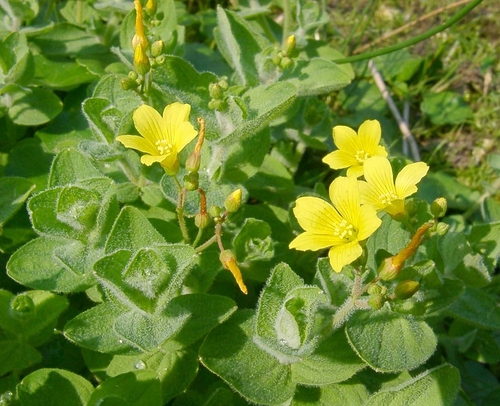
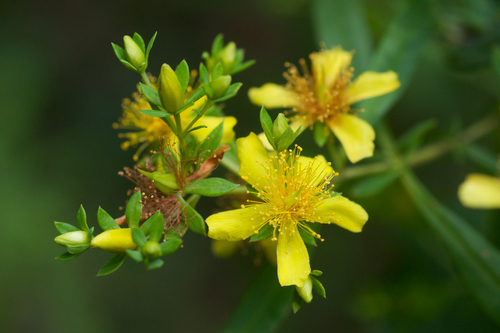
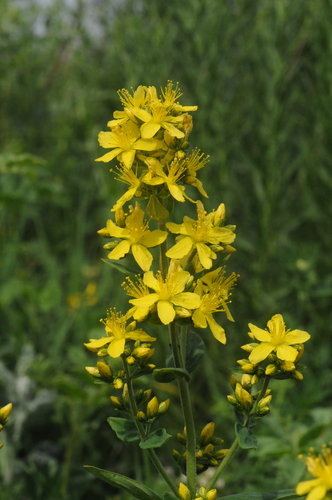
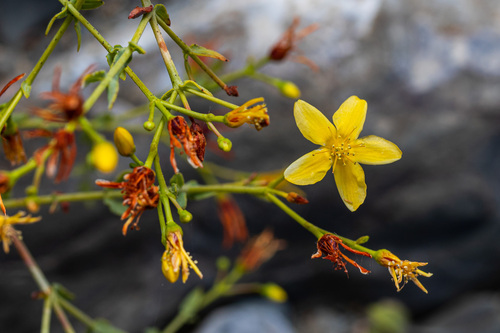
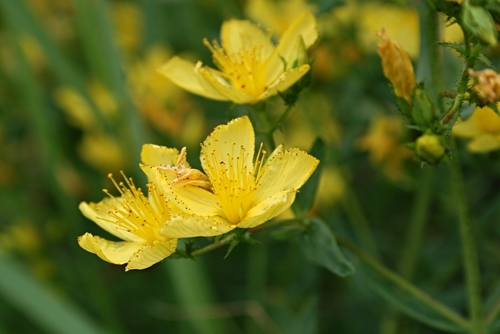
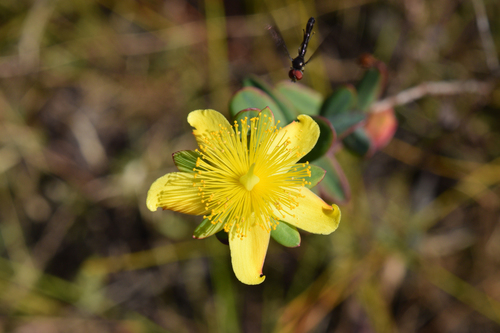
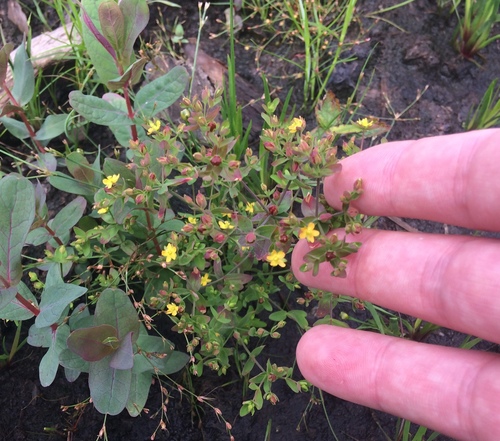
The inflorescence of Hypericum boreale is almost identical to that of Hypericum majus, but differs in a few key traits: H. boreale has more oblong, blunt sepals, fewer-flowered clusters that are more leafy, and broader, rounder leaves. The inflorescence is made up of single flowers, or open clusters of a few to several flowers, growing at the tips of stems and branches. A pair of leaf-like bracts sits at the base of each flower stalk. H. boreale’s flowers are yellow, and measure less than a quarter inch in diameter. Each flower has 5 narrow petals with blunt tips, 5 green blunt-tipped sepals, and 3 styles that are united at their base. 7 to 18 slender stamens are closely grouped around the center of the flower. Its leaves are simple, arranged oppositely along stems, and shaped oblong, oval or elliptic. They grow to around half an inch long and a quarter inch wide. Both the tips and bases of leaves are rounded, or taper to a blunt tip, and 3 to 5 prominent veins are visible. The plant’s stems are hairless, and branch either on the upper part of the plant or from underground rhizomes. The fruit is an oval to ellipsoid capsule around an eighth of an inch long, colored reddish to deep purple. This species occurs in the continental United States and parts of Canada. Its specific distribution covers the Pacific Northwest, the Midwest, the Great Lakes region, the Eastern Seaboard, and Eastern Canada. It shares a similar range to the related species H. majus, but its range is more limited. Hypericum boreale is almost always found in wetlands. It is most often located on pond edges, stream banks, marshes, and bogs. It grows successfully in coarse and moderate textured soils, but not in fine textured soils. It is cold tolerant, but requires at least 90 frost-free days per year and cannot survive sustained temperatures below −33 °F (−36 °C). It cannot tolerate salt in soil, and requires a soil pH between 4.4 and 6.0 to survive.