About Hypericum androsaemum L.
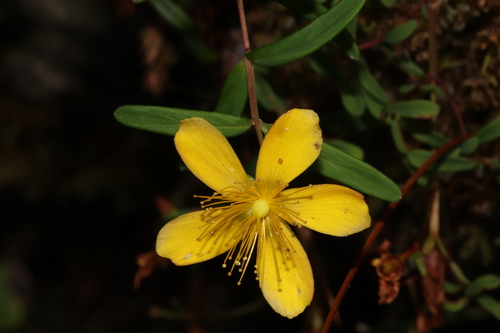
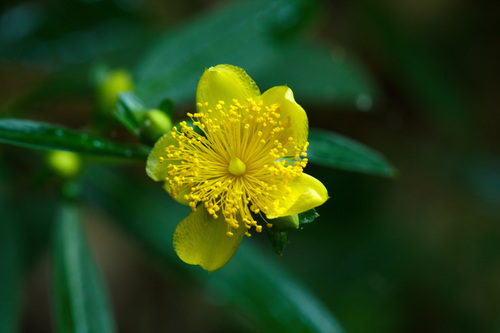
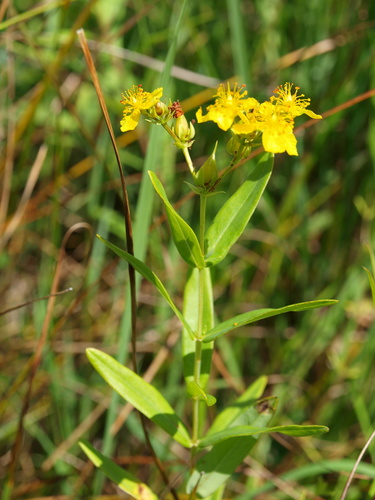
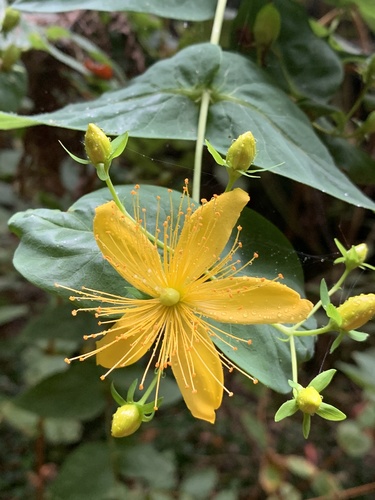
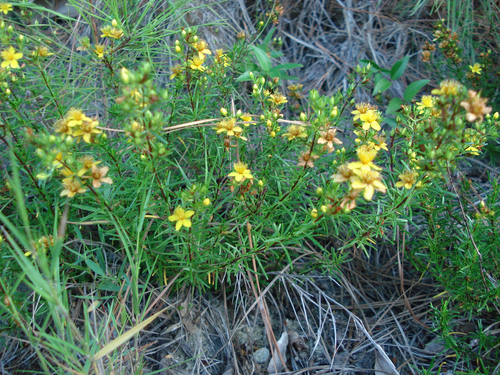
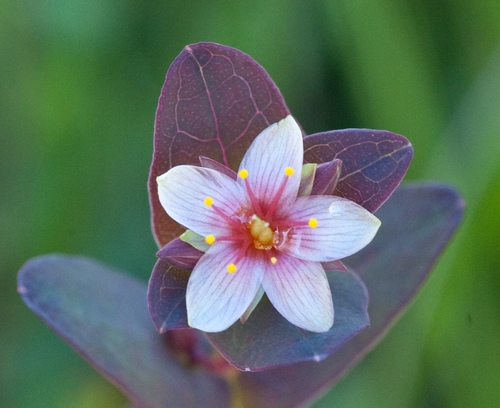
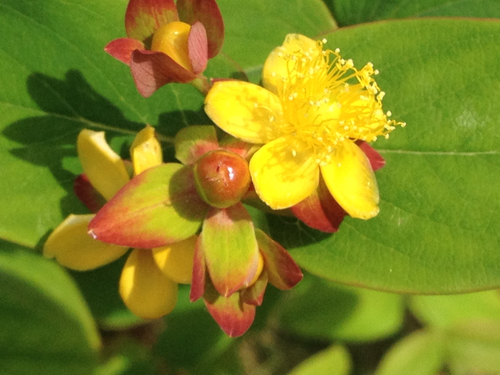
Hypericum androsaemum L. is a small bushy shrub that grows 30 to 70 centimetres (12–28 in) tall. It produces many upright, erect stems that do not creep along the ground, and mature stems are cylindrical in shape, with bark marked by longitudinal grooves or scale-like patterns. Oval-shaped leaves grow along its stems; they are typically green with a red tint, and hold small, closely visible glands on their surface that are filled with red pigment. Its flowers are yellow, 1.5–2.5 cm in diameter, with five petals and numerous stamens. Unlike any other Hypericum species, its berries shift color from red to black and stay soft and fleshy even after ripening. This species has a broad native distribution, and is most densely concentrated in Western Europe. It is particularly abundant across the British Isles (with the exception of the Scottish Highlands), in the Ardennes forest shared by Belgium and France, and along the western coast of France. Other native European populations occur in the Pyrenees Mountains, across northern Spain and Portugal, around Genoa and in parts of central Italy. Scattered populations have been recorded across Germany, as far north as Denmark, and also in Switzerland, Austria, and the Balkans. Outside of Europe, H. androsaemum grows in northern Turkey, the North African coast, the Caucasus, and Iran. While it was once thought to be native to the island of Corsica, it is now considered extinct there. H. androsaemum has become naturalized or invasive in non-native regions. In Australia, it grows densely in the Otway Ranges, South Gippsland Hills, Dandenong Ranges, the Blue Mountains, and the area surrounding Mansfield. A small number of scattered populations exist on Tasmania, where it is not considered problematic. In New Zealand, it occurs on both North and South Islands frequently enough to be an encroaching weed. It grows in damp, shady areas across a wide range of elevations, from low-lying regions up to 1,800 m (5,900 ft), and requires heavy annual rainfall, typically more than 750 mm (30 in). Seeds of H. androsaemum germinate in autumn. The plant flowers when it is between 18 and 24 months old, usually from late spring to early summer, and fruit ripens by late summer. It is partially deciduous: it loses most of its foliage in autumn, and regrows rapidly every spring. When cultivated, H. androsaemum requires very little maintenance. It is generally free of pests and diseases, and is deer resistant. It can, however, be affected by nematodes that cause root rot; pest insects including thrips and scale have also been recorded on the species. In hot, humid climates, it is susceptible to wilting and unrelated root rot. It tolerates both moderately acidic and moderately alkaline soils, and can survive drought and freezing temperatures as low as −20 °C (−4 °F). While it grows best when planted roughly 90 cm (3 ft) apart from other plants, it will self-sow via seed in its growing area if left unmanaged, forming a dense ground cover. After it loses its leaves in autumn, it can be cut back as needed, and will regrow from its base the following spring. Most Hypericum species are difficult to germinate due to strong seed dormancy. H. androsaemum has both physiological dormancy and chemical dormancy, meaning seed germination can be triggered by both physical and chemical factors. Room-temperature water or the plant hormone gibberellic acid are the most effective treatments to break seed dormancy. New specimens are propagated by sowing non-dormant seeds in a 10 °C (50 °F) greenhouse in spring, under a very thin layer of soil. Once seedlings are large enough to handle (after 1–3 months), they are transplanted into individual pots. After the last winter frost, the new plants are moved to their permanent outdoor locations. As an alternative to seed propagation, semi-hardwood cuttings 10–12 cm long are sometimes taken in autumn. These cuttings are held in a frame through the rest of autumn and winter, and can be replanted the following spring. Like many other Hypericum species, H. androsaemum is a medicinal plant used in folk medicine. It is used as a diuretic, to treat sciatica and gout, to slow bleeding, and to speed healing of burns and minor wounds. Unlike many other Hypericum species, H. androsaemum does not contain hypericin, a compound that causes skin irritation and other unwanted side effects. Because of this, it is more widely used in topical applications and skincare. This lack of hypericin also makes it useful as an antidepressant, and testing has shown it appears to be at least as effective as H. perforatum for this purpose. In Portugal, its leaves are used to treat liver, kidney, and bladder conditions, while in England, leaves are mixed with lard to create an ointment for cuts and other wounds. Laboratory testing has confirmed the antioxidant properties of H. androsaemum berries, which supports their traditional use in teas as antihepatotoxics or diuretics.