About Hypercompe scribonia Stoll
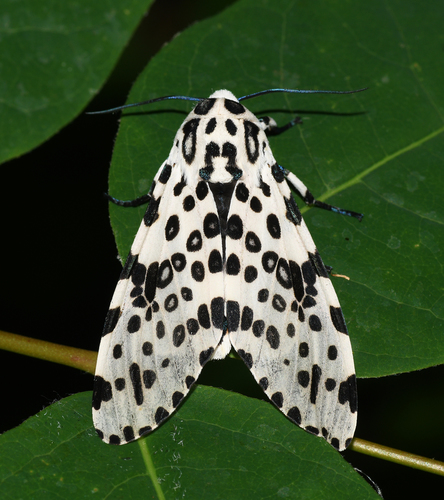
The giant leopard moth, scientifically named Hypercompe scribonia Stoll, is a member of the moth family Erebidae. It is distributed across North America, ranging from southern Ontario, and the southern and eastern United States including New England, through Mexico, and southward to Colombia. An outdated scientific name, Ecpantheria scribonia, is still sometimes used for this species. Giant leopard moths are known to be attracted to bitter, unripe vegetables and broccoli flowers. This species has a total wingspan of 76 mm (3 in). Its wings are bright white, marked with a neat pattern of black blotches that are either solid or hollow. The upper side of the moth's abdomen is dark blue with orange markings, while the underside is white with solid black spots; males also have a narrow yellow line along the sides. The moth's legs bear black and white bands. Adult giant leopard moths are strictly nocturnal, and generally do not fly before nightfall. This species shows distinct sexual dimorphism in size: adult males reach around 51 mm (2 in) in length, while adult females grow no larger than 30 mm (1.2 in). The giant leopard moth requires two years to complete its full life cycle. In Missouri, adults are active from May to September, and the species produces multiple generations per year. During mating, the male's wings cover most of the female's abdomen. This can sometimes cause the female to lose wing scales, which negatively affects her flight efficiency. Mating sessions in this species are notably long, lasting more than 24 hours. The moths stay mostly immobile throughout the entire mating process, but will move from place to place to regulate their body temperature: they walk into shaded areas if they get too hot, and into sunlight if they get too cold. Only the male moves during this process, while the female folds her legs to make it easier for the male to carry her. The caterpillar of this species is a "woolly bear" type, with a thick coat of black bristles called setae, and red or orange bands between its body segments. These bands become visible when the caterpillar rolls into a ball for defense. Like the banded woolly bear caterpillar, the giant leopard moth caterpillar's hairs are not urticating, nor venomous, and do not typically cause skin irritation. The species overwinters in the caterpillar stage, often sheltering under the bark of decaying wood. Fully grown caterpillars reach 7.6 cm (3 in) in length. Recorded food plants for giant leopard moth caterpillars include a variety of broadleaf plants, such as broadleaf plantains, dandelions, and violets.