About Hypena proboscidalis (Linnaeus, 1758)
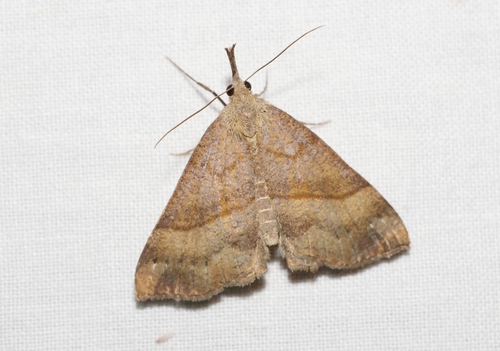
Technical description and variation: The wingspan of Hypena proboscidalis ranges from 25 to 38 mm. Its forewings are grey-brown with many dark transverse striae. Females have an additional brownish-yellow suffusion across the forewings. All forewing lines are dark brown: the inner line is curved or bent at its middle; the outer line is oblique, nearly straight, slightly incurved at the costa, with dark brown shading along its inner edge; the subterminal line is cloudy and partially interrupted, marked above the middle with black dashes tipped with white. This section of the subterminal line is followed by a brown cloud, whose subapical edge is oblique. The hindwing is pale greyish. As a general rule, most females are brownish – per Warren in Seitz, this characteristic was the basis for Tutt naming the variation ab. brunnea. Most males are grey, lacking this brownish colouration. The form deleta Stgr., found in the Altai Mountains, Amurland, and Kamchatka, is paler than the base form, with yellowish forewings sprinkled with brown and less distinct markings. Form tatorhina Btlr., currently recognized as the full species Hypena tatorhina Butler 1879 from Japan, is small and grey in both sexes, with dingy fuscous suffusion and a black spot in the cell. Its hindwing is fuscous. A distinct undescribed form comes from Omei-shan and Tatsienlu in West China. The subspecies flexilinea Warren, newly described at the time of this source, has dark grey-brown females: the transverse striae and the shades preceding the lines are dark smoky fuscous, and the outer line is visibly bent above the middle. Males of this subspecies have only slight dark shading. A similar but smaller form, indicalis Guen., occurs in the Goorais Valley, Kashmir. In this form, the outer line tends to be elbowed on both folds. Males of indicalis have no dark shading at all, and bear a small black dot in the cell and a large black spot at the end of the cell. Distribution and habitat: This species is found in Europe north to the Arctic Circle. Eastward, its range extends across the Palearctic, including North Africa, Siberia, Iran, the Altai Mountains, Kamchatka, Kashmir, India, China, Korea, Japan and Taiwan. In the Alps and India, it can be found at elevations over 1600 metres.