About Hyoscyamus muticus L.
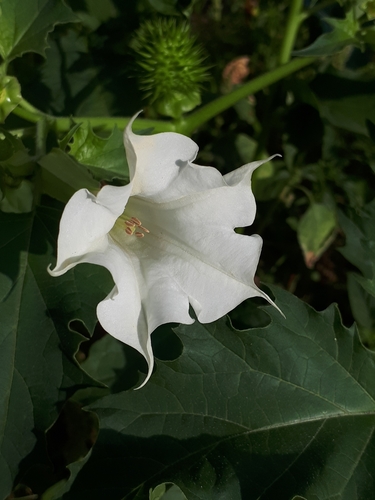
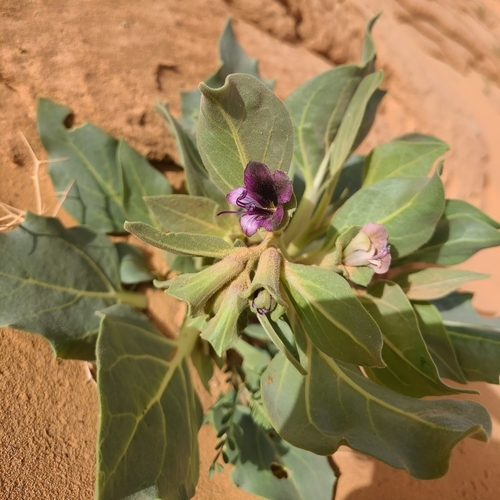
Egyptian henbane, scientifically named Hyoscyamus muticus L., is a perennial herb or shrub that can grow up to 1.5 metres (4 ft 11 in) tall. It is a stout succulent, with long stems that produce many branches in their upper sections. Its lower leaves are broad, while upper leaves are narrower. Flowers are borne in dense inflorescences that reach up to 30 centimetres (12 in) long; the flowers have a white or green corolla, with upper lips colored deep purple-violet. Its fruit is a capsule. The leaves of this plant are high in alkaloids, including scopolamine, which is used in pharmaceutical products. When released slowly, scopolamine reduces nausea caused by motion sickness or experienced during post-operative recovery. When used in eye drops, it dilates the pupils and paralyzes the focusing muscles, which makes it useful for optical surgery. Roasted seeds of Egyptian henbane are used to make an intoxicating drink. Leaves are smoked for their intoxicating effect, and also to relieve asthma symptoms. Leaves may also be applied as a poultice to ease pain. This plant is toxic in higher doses, and deaths have been reported after eating locusts that had consumed Egyptian henbane. The Tuareg people use it as a fish poison. An overdose causes symptoms including an extremely dry throat, constipation, a rapid pulse, blurred vision, excitement, hallucinations, delirium, and death. The wives of Roman emperors Augustus and Claudius used this plant as a poison to eliminate rivals. In February 1881, a group of Tuaregs approached the survivors of the Flatters Expedition and sold them milk, meat, and dates at a high price. The dates were found to be poisoned with a substance that caused dizziness and psychosis, which came from a plant called Falezlez by the Tuaregs and El Bettina by the Arabs (Hyoscyamus falezlez). This poison induced a burning sensation in victims' lungs, and caused them to rush about madly and fire off their guns.