About Hyophorbe verschaffeltii (W.Bull ex J.Dix) H.Wendl.
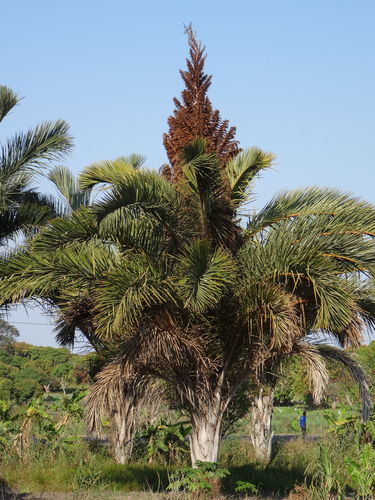
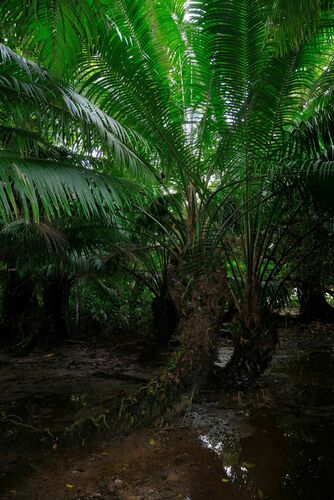
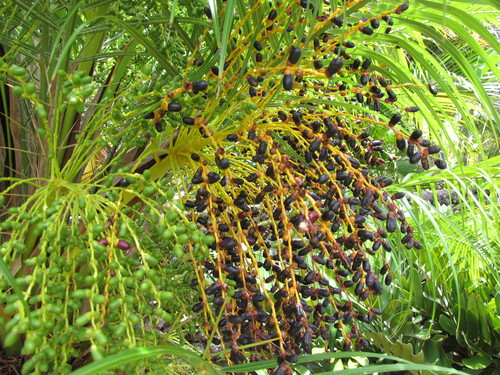
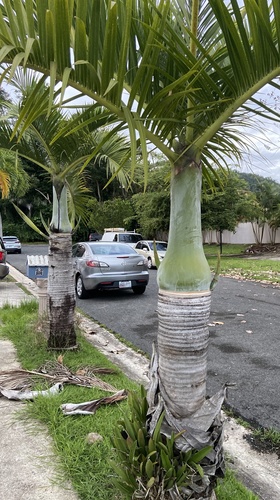
Hyophorbe verschaffeltii, commonly called spindle palm, typically reaches 6 metres (20 ft) in height. It produces lightly recurved pinnate leaves, with 8–10 leaves held somewhat erect, and has an elegant appearance that makes it prized for landscaping in tropical and semi-tropical regions around the world. Spindle palms have a crownshaft that fades to a light gray-green as the palm ages. On mature specimens, horn-shaped flower spikes grow from below the crownshaft. Its ripe fruits darken to a black color. This species was named after Ambroise Verschaffelt (1825–1886).
The spindle palm sometimes resembles its closest relative, the bottle palm (Hyophorbe lagenicaulis), and both species develop swollen trunks. The spindle palm’s trunk becomes swollen in the middle, taking on a spindle shape, while the bottle palm’s trunk continues to swell at the base, often taking on the shape of a bottle. Spindle palm foliage is also more yellowish than that of the bottle palm.
Spindle palms are endemic to Rodrigues Island, Mauritius. It is threatened by habitat loss, with only around fifty specimens remaining in the wild. However, the species’ survival is assured because it is widely cultivated across tropical regions of the world.
Spindle palms are not very cold tolerant. They lose all their leaves at 0 °C (32 °F) and may be killed by temperatures below this. If a palm does survive a freeze, the next few new leaves that emerge will be stunted. In the United States, spindle palms grow in south Florida, and in isolated suitable microclimates along the coastlines of the Tampa-St. Petersburg-Clearwater area, as well as the Cape Canaveral and Satellite Beach areas of central Florida. They grow well as container plants, which can be protected from freezing temperatures.