About Hyophorbe lagenicaulis (L.H.Bailey) H.E.Moore
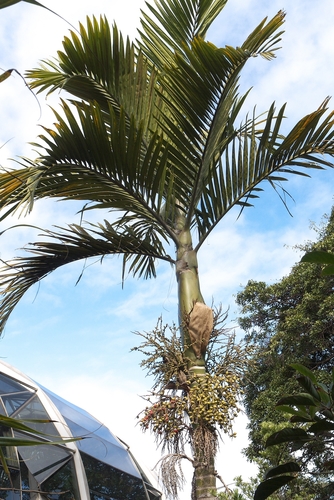
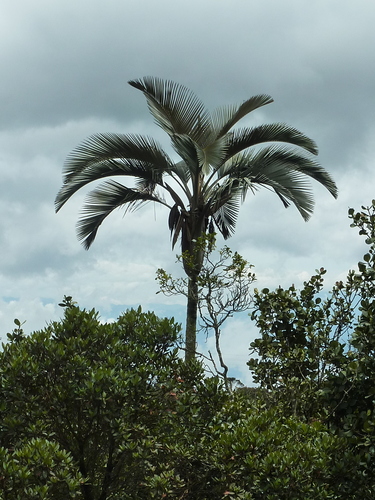
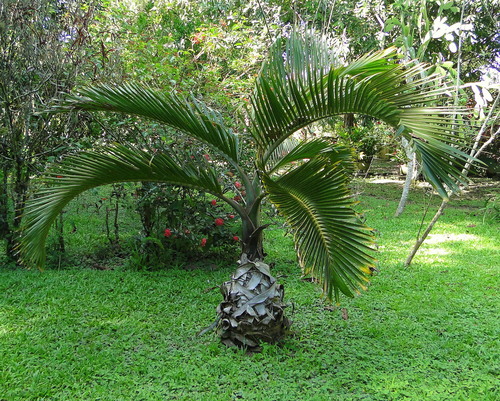
This species, commonly called bottle palm, has a large, sometimes extremely swollen trunk. Contrary to a common myth, this swollen trunk does not function as water storage for the palm. At any given time, bottle palms only have four to six fully open leaves. The leaves of young bottle palms have a red or orange tint, and mature leaves develop a deep green color. The palm's flowers grow from underneath the crownshaft. Bottle palm is often mistaken for its relative, the Spindle Palm, which also has a swollen trunk. Spindle Palm trunks swell in their middle section, matching the shape of a spindle, while bottle palm trunks swell near the base and taper as they go upward. Bottle palm inflorescence branches in four orders, and it produces 2.5 cm fruits that can be orange or black. The trunks of both bottle palm and Spindle Palm become increasingly more slender as the palm ages. On Mauritius, the only other surviving Hyophorbe species is the extremely rare, critically endangered Hyophorbe vaughanii. Bottle palm can be told apart from this species by its swollen trunk when young, its much smaller 2.5 cm orange or black fruits, and its four-order branching inflorescence, compared to the three-order branching of H. vaughanii. Bottle palm is naturally endemic to Round Island, located off the coast of Mauritius. Although habitat destruction may eliminate the last remaining wild individuals of this species, the species is guaranteed to survive because it is widely planted as a specimen plant throughout tropical and subtropical regions worldwide. It is one of three naturally occurring Hyophorbe species native to Mauritius, and one of only two that remain extant. Bottle palm is very sensitive to cold, and will be killed when exposed to 0 °C (32 °F) or colder temperatures for any significant length of time. It can survive a short, light frost, but will suffer damage to its foliage. Within the United States, only southern Florida and Hawaii provide safe locations to grow bottle palm outdoors, though mature flowering specimens can occasionally be found in favorable microclimates around Cape Canaveral and the Tampa-St. Petersburg-Clearwater area in coastal central Florida. Bottle palm grows well as a container palm in other locations, as long as it is protected from cold and not overwatered.