About Hymenops perspicillatus (Gmelin, 1789)
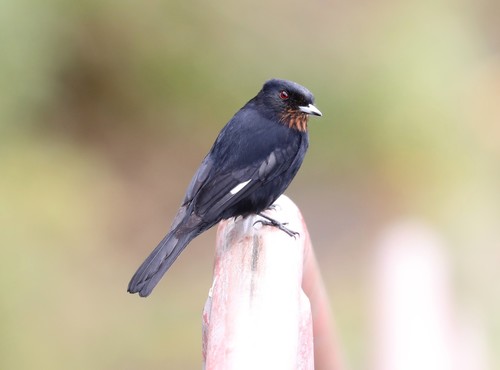
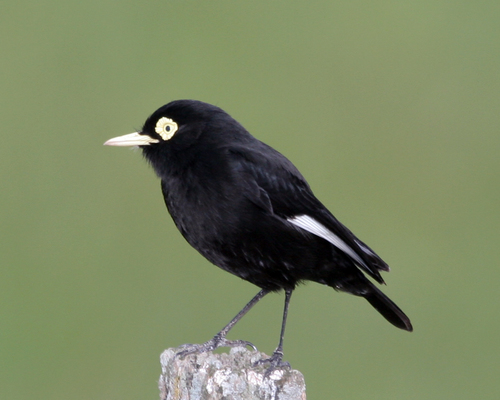
The spectacled tyrant, Hymenops perspicillatus, measures 13 to 16 cm (5.1 to 6.3 in) in length and weighs approximately 20 to 25 g (0.71 to 0.88 oz). Adult males of the nominate subspecies are mostly black, with primaries that are mostly white apart from black bases and tips. They have bare, fleshy green-tinged yellow skin surrounding the eye, which gives the species its common English name. Adult females have a dark brown crown, a buffy or buff-white supercilium, pale lores, and a smaller eye-ring than males; the rest of their face is mostly pale dusky. Their back is dark brown with black streaks. Their wings have rufous flight feathers and buffy edges on the coverts that form two distinct wing bars. Their tail is dark, and their underparts range from pale dusky to whitish, with dusky streaks covering the breast. The subspecies H. p. andinus is slightly larger than the nominate subspecies. Adult males of H. p. andinus have less white on their wings than nominate males, and adult females have less bold breast streaking than nominate females. Juveniles of both subspecies resemble the adult females of their respective subspecies. Both sexes of both subspecies have a yellow iris and black legs and feet. Males have a pale yellow bill, while females have a dusky maxilla and a brown mandible. The spectacled tyrant has a disjunct distribution. The nominate subspecies occurs in coastal southeastern and far southern Brazil, as well as in Bolivia, Paraguay, Uruguay, and Argentina extending south to Río Negro Province. Subspecies H. p. andinus is found in Chile from the Atacama Region south to the Los Lagos Region, and also in a separate range in Argentina that extends south to northern Santa Cruz Province. The species has been recorded as a vagrant in Peru and far northeastern Brazil. The spectacled tyrant inhabits open landscapes including marshes, grasslands, and pastures; grasslands and pastures are often, but not always, located near water. In Brazil, it occurs from sea level up to 2,000 m (6,600 ft) in elevation.