About Hymenopappus filifolius Hook.
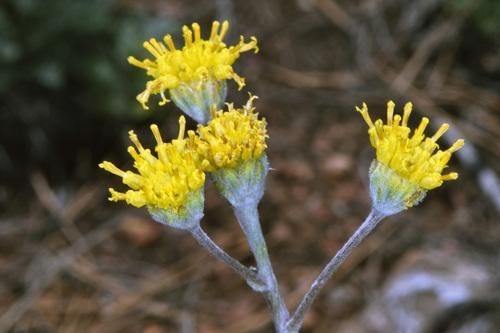
Hymenopappus filifolius Hook. is a North American flowering plant species in the daisy family, with the common names fineleaf hymenopappus and Columbia cutleaf. It is native to western and central North America, ranging from Alberta and Saskatchewan south to Chihuahua and Baja California. This species can grow in a range of habitats, most often in arid regions. It is variable in appearance, and the species has many recognized varieties. It is a taprooted perennial herb that can grow either as a small ground clump or as an upright, open cluster of stems reaching up to 1 meter (40 inches) tall. Almost all of its leaves grow at the base of the plant, forming a woolly gray-green patch. Individual leaves can be up to 20 centimeters (8 inches) long, and are divided into blunt, thread-like leaflets. The leaves are glandular, with hairiness ranging from sparse to very woolly; their surface is dark green beneath the coating of white wool. Stems end in a branching inflorescence made up of knob-shaped discoid flower heads, which are filled with golden yellow or white disc florets. This species produces no ray florets. The many recognized varieties of this species and their recorded ranges are as follows: Hymenopappus filifolius var. cinereus, found in Arizona, Colorado, Utah, New Mexico, Texas; Hymenopappus filifolius var. eriopodus, a white-flowered variety native to California, Nevada, Utah; Hymenopappus filifolius var. filifolius, found in Idaho, Oregon, Washington; Hymenopappus filifolius var. idahoensis, found in Idaho; Hymenopappus filifolius var. lugens, found in Arizona, California, Nevada, Utah, New Mexico, Baja California; Hymenopappus filifolius var. luteus, found in Utah, Wyoming, Colorado; Hymenopappus filifolius var. megacephalus, found in California, Nevada, Utah, Arizona, Colorado; Hymenopappus filifolius var. nanus, found in Arizona, California, Nevada, Utah; Hymenopappus filifolius var. nudipes, found in Utah, Wyoming; Hymenopappus filifolius var. parvulus, found in Colorado; Hymenopappus filifolius var. pauciflorus, found in Utah, Arizona, Colorado; Hymenopappus filifolius var. polycephalus, found in Alberta, Saskatchewan, Colorado, Kansas, Montana, Nebraska, North Dakota, South Dakota, Wyoming; and Hymenopappus filifolius var. tomentosus, found in Utah. For traditional uses, the Zuni people apply a poultice of chewed root mixed with lard to swellings, drink a warm decoction of the root as an emetic, and use the root as chewing gum.