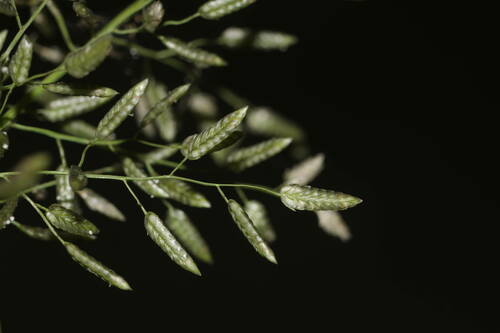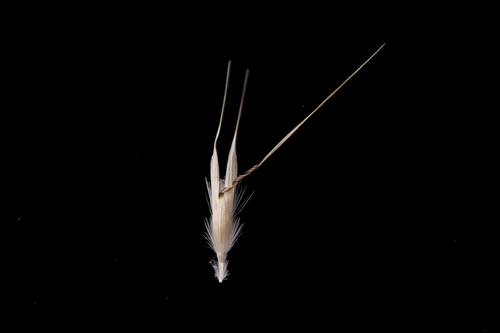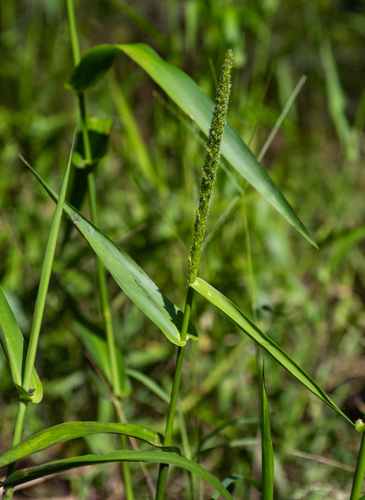
About Hymenachne amplexicaulis (Rudge) Nees
Hymenachne amplexicaulis has the common name West Indian marsh grass in the United States, and Olive hymenachne in Australia; this text will refer to it simply as hymenachne. It is a New World species belonging to the genus Hymenachne. The genus name Hymenachne comes from Greek words: hymen meaning "membrane", and achne meaning "chaff, glume, scale". The species epithet amplexicaulis comes from Latin, and literally means "embracing the stem" or "stem-clasping". This is a freshwater species, native to the tropical and subtropical regions of the West Indies, Northern South America, and Central America. Hymenachne prefers constantly inundated soil. It can survive comfortably in around one meter of water for up to 20 years. In Australia, the species survives poorly where flooding exceeds 1.2 meters deep. However, in its native range in Venezuela, and in invaded areas of Florida, hymenachne has been documented to survive in water deeper than 1.2 meters for almost a full year. Hymenachne has also been found persisting as floating mats in water more than 4 meters deep, where individuals were likely dislodged after a storm event. In contrast, hymenachne has not been recorded surviving at sites that dry out completely. Hymenachne colonizes and forms dense monocultures in floodplains, roadside ditches, and lake margins, both within its native range and in areas where it has invaded. It is often found colonizing areas that have little shading and little competition from other plant species. While limited information is available on hymenachne's soil preferences, it has been found growing in deep, poorly drained muck soils in Florida. It does not grow in waters with a significant salt concentration.