About Hylocichla mustelina (Gmelin, 1789)
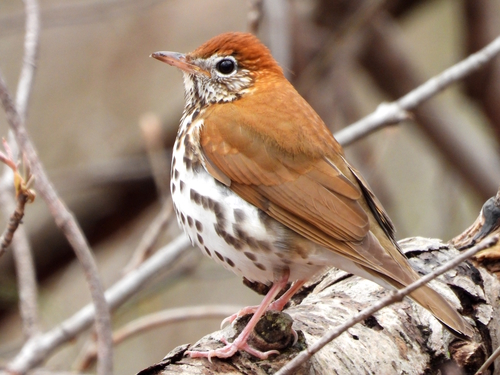
Hylocichla mustelina, commonly known as the wood thrush, has the following physical description. Adult wood thrushes measure 18 to 21.5 cm (7.1 to 8.5 in) in length, with a 30 to 40 cm (12 to 16 in) wingspan and a body mass of 48 to 72 g (1.7 to 2.5 oz). Standard measurements include a 9.6 to 11.6 cm (3.8 to 4.6 in) wing chord, a 1.6 to 2 cm (0.63 to 0.79 in) bill, and a 2.8 to 3.3 cm (1.1 to 1.3 in) tarsus. This species is distinctly larger than the sympatric Catharus thrushes it often shares range with, and slightly smaller than the common American robin. The maximum recorded wild lifespan for a wood thrush is 8 years and 11 months. Their crown, nape, and upper back are cinnamon-brown, while their back, wings, and tail are a slightly duller brown. Their breast and belly are white, marked with large dark brown spots across the breast, sides, and flanks. They have a distinct white eye ring and pink legs. Unlike the wood thrush, other similar brownish thrushes have finer breast spotting. Juvenile wood thrushes look similar to adults, but have extra spots on their back, neck, and wing coverts. Males and females are similar in both size and plumage. Regarding distribution and habitat, the wood thrush’s breeding range stretches from southern Canada (Manitoba, Ontario, and Nova Scotia) south to northern Florida, and from the Atlantic coast west to the Missouri River and the eastern Great Plains. It is a migratory species that spends the winter from southern Mexico through Panama in Central America, mostly occupying lowlands along the Atlantic and Pacific coasts. It generally arrives on the U.S. Gulf Coast during the first week of April. Fall migration typically starts in mid-August and continues through mid-September. Migration occurs at night; wood thrushes navigate using star positioning and detect the Earth’s magnetic field to orient themselves. For breeding, wood thrushes prefer deciduous and mixed forests, specifically late-successional, upland mesic forests with a moderately dense shrub layer. They favor areas with running water, moist ground, and high understorey cover. Breeding habitat usually includes trees taller than 16 m (52 ft), a fairly open forest floor, moist soil, and leaf litter, with substrate moisture being more important than either canopy cover or access to running water. Wood thrushes can breed in habitat patches as small as 0.4 hectares (0.99 acres), but these smaller patches carry higher risks of predation and nest parasitism. The wood thrush breeding range has expanded northward, and it has displaced the veery and hermit thrush in some locations. In recent times, forest fragmentation has left the species increasingly exposed to nest parasitism by brown-headed cowbirds, and it also faces habitat loss in its winter range. Wood thrushes are monogamous. Breeding pairs form between mid-April and early May, and typically remain together through the entire breeding season. Most individuals find a new mate each year, and neither mate guarding nor extra-pair copulations have been observed in this species. Some male wood thrushes arrive at breeding grounds several days before the earliest females, while other males arrive at the same time as females, and establish territories ranging from 0.08 to 0.8 hectares (one-fifth of an acre to two acres) in size. Courtship involves the female leading silent circular flights 1–1.8 m (3.3–5.9 ft) above ground, while the male chases. Six or more of these flights generally happen in succession. Between flights, pairs perch together and the male feeds the female. Males begin singing at dawn and dusk a few days after arriving at breeding grounds. Early in the breeding season, males sing from high perches in the tallest trees; as the season goes on, they sing shorter, less elaborate songs from lower perches. Each day’s singing starts and is most intense just before sunrise. Males may sing throughout the day, but singing is especially common at dusk. The singing season typically ends by late July. The female usually chooses the nest site and builds the nest, though there is some indication males can influence site selection by perching nearby and singing. In most cases, the female makes the final decision to accept or reject a male-suggested nest site. Nests are usually placed in dense vegetation in a tree or shrub, which provides concealment and shade. They are constructed from dead grasses, stems, and leaves, lined with mud, and positioned in the fork of a horizontal branch. Nests are never reused. Breeding pairs typically attempt two broods per season, and may build three to four separate nests before successfully producing young. Two to four pale blue eggs are laid, one per day. Only the female incubates the eggs, over a period of 11 to 14 days, with an average incubation time of 13 days. Like all passerines, wood thrush chicks are altricial when they hatch: they are mostly naked with closed eyes. The female broods the chicks during the first four days after hatching. Both parents feed nestlings and remove fecal sacs from the nest. Chicks fledge 12–15 days after hatching, but parents continue feeding them until they become independent and leave the parental territory at 21–31 days old. Young wood thrushes are able to start breeding the following summer. Most females lay their first eggs in mid-May, though older females may begin laying earlier. Pairs usually attempt to rear a second brood no later than late July, and the last young fledge around mid-August. Roughly half of all wood thrush pairs successfully raise two broods.