About Hyllus diardi (Walckenaer, 1837)
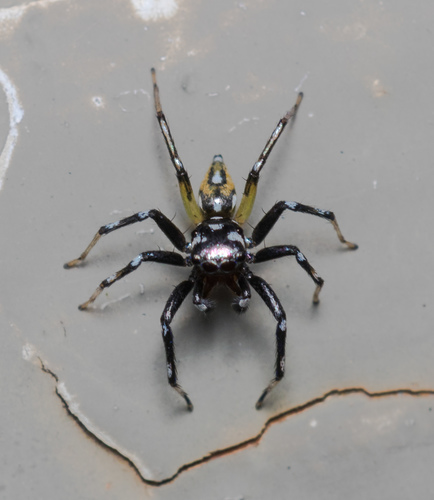
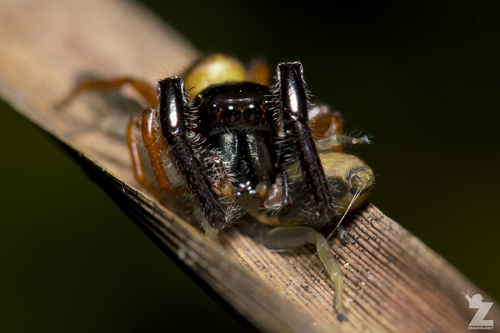
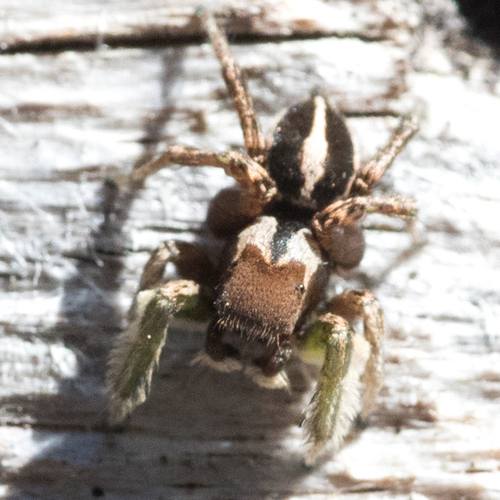
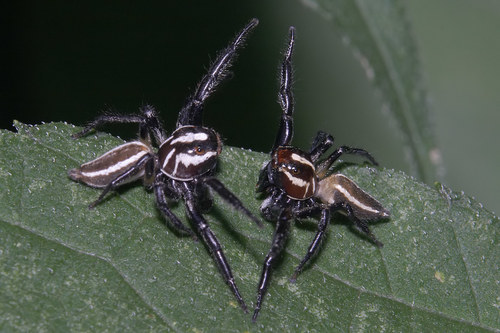
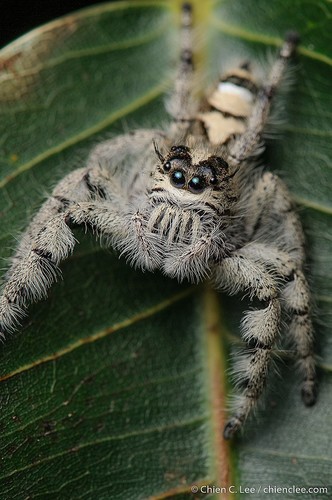
Hyllus diardi (Walckenaer, 1837) is a relatively large species of jumping spider. Males have an approximate total body length of 12 mm, and their carapace measures about 5.8 mm in length. The male carapace is dark brown, sparsely covered with iridescent metallic yellow setae, and has a central line of white setae. The male abdomen is yellowish brown, covered with iridescent metallic yellow setae, and marked with a line of dense white setae. Females are slightly larger than males, reaching a total body length of about 12.3 mm, with a carapace length of 4.8 mm. The female carapace is reddish-brown with short yellow setae, and features two distinctive tufts of long dark setae below the posterior median eyes that resemble "horns". The female abdomen is yellow with grey setae and is decorated with inverted chevron patterns. Males can be distinguished from closely related species by their short tibia, which is about as long as it is wide, and is approximately half the length of the cymbium. They are also distinguished by the flat, wide tip of the retrolateral tibial apophysis, which is directed dorsally. Females are characterized by very large, egg-shaped copulatory openings that are longer than wide, and significantly wider than the median septum. H. diardi is widely distributed across Southeast Asia and southwestern China. It has been recorded from China, Myanmar, Thailand, Laos, Vietnam, Malaysia, the Philippines, and Indonesia. This jumping spider lives in various environments across its range in tropical and subtropical Asia.