About Hyles livornicoides Lucas, 1892
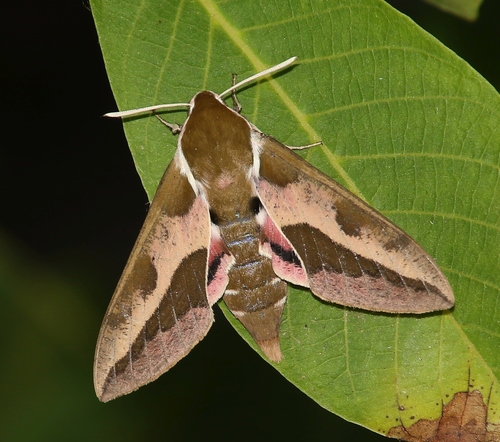
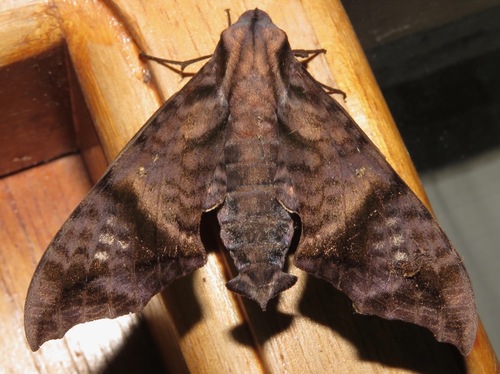
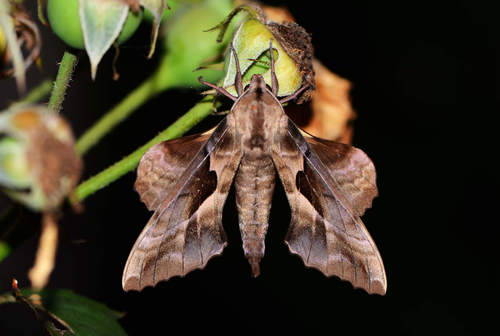
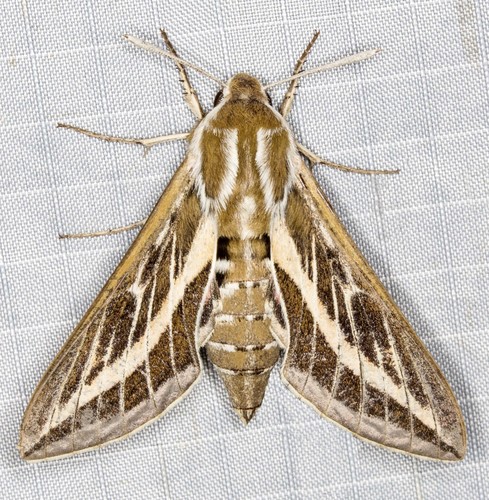
This species is scientifically named Hyles livornicoides Lucas, 1892. In its early caterpillar stages, Hyles livornicoides is green with a dark dorsal line that ends at a stumpy black tail spike. During the third and fourth instars, caterpillars develop black-edged orange eyespots along each side, connected by a pale line. The spiracles turn white with black rings, and each spiracle is surrounded by smaller black-edged white spots. In the final instar, caterpillars may be green, brown, or black, and their tail spike becomes strongly curved backwards. The dorsal line may be white (sometimes with orange edges) or plain orange, and the line connecting the eyespots becomes paler and wider, almost entirely covering the eyespots. Fully grown caterpillars of this species can reach up to 55 mm in length. Caterpillars prefer to burrow into soil to pupate, but they will also pupate in crevices or under debris. The pupa is approximately 30 mm long. As an adult moth, Hyles livornicoides has brown forewings marked with white patterns, including a distinct white stripe. Each hindwing is brown with a broad diagonal pink stripe. The average adult wingspan is around 60 mm. Among four closely related moth species, the upper side of the abdomen has at least three pairs of subdorsal black spots, and the median white line has a row of small black spots on either side, with one spot per segment. For Hyles livornicoides, the presence of these dorso-lateral spots can be confirmed via a few remaining scales on the A3 section of the abdomen, though the full extent of the spots on this section cannot be determined. The spots are present on the A4 section of the abdomen, but they are restricted to the fringe of the tergite. Hyles livornicoides is found across all of mainland Australia, occurring in New South Wales, South Australia, the Northern Territory, Queensland, Victoria, the Australian Capital Territory, and Western Australia. Sightings form a scattered distribution: there are very few sightings in northern Western Australia, while sightings are most frequent along a coastal area north of the border between New South Wales and Queensland. The Arrente people associate Hyles livornicoides with specific plant taxa: tarvine (Boerhavia diffusa and B. schomburgkiana), emu bush (Eremophila longifolia), and pink rockwort (Sedopsis filsonii). These plants provide forage and habitat for the species' caterpillars.