About Hyles euphorbiae Linnaeus, 1758
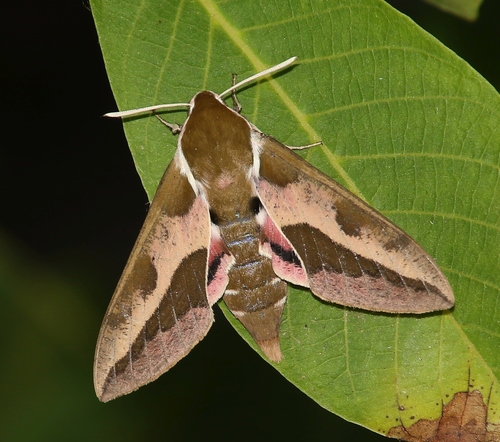
This is the spurge hawk-moth, Hyles euphorbiae Linnaeus, 1758. Its fore wings are grey, marked with an almost square olive-brown blotch, another olive-brown blotch near the middle at the wing base, and a long oblique olive-brown band that starts as a point at the extreme wing apex, gradually widening until it reaches the very broad margin. The hind wings are pink, with a black blotch at the base, a black band halfway between this base blotch and the margin, and a snowy-white blotch at the anal angle. The thorax and body are olive-brown, with a white line on each side of the thorax right at the wing base; this line runs along each side of the head just above the eye, and the two lines meet at the nose. At the base of the body on each side, there are two square black spots and two square white spots; further along closer to the apex, also on each side, there are three white lines. The caterpillar is smooth and black, covered with countless whitish dots. It also has eleven large whitish spots arranged in a row on each side of the back, and beneath these spots are an equal number of spots of the same size, colored bright coral-red. The head is the same coral-red, and a coral-red line runs all along the back from the head to the horn; the horn is red at the base and black at the tip. This caterpillar feeds on sea-spurge. The chrysalis is pale brown, finely marked with black lines and dots arranged in a network pattern. It buries itself in loose dry sand on the sea coast. Eggs are covered with a sticky liquid gum that lets them stick to the small leaves of spurge. They hatch after a fortnight, producing small black caterpillars. The characteristic white and red spots develop as the caterpillar grows; after a few weeks, it becomes a very beautiful, highly conspicuous insect that attracts sea-gulls and terns, which eat large numbers of the caterpillars. The authors of this description have never personally found either the caterpillar or the adult moth, and the description of the caterpillar is taken from the Entomological Magazine.