About Hylephila phyleus (Drury, 1773)
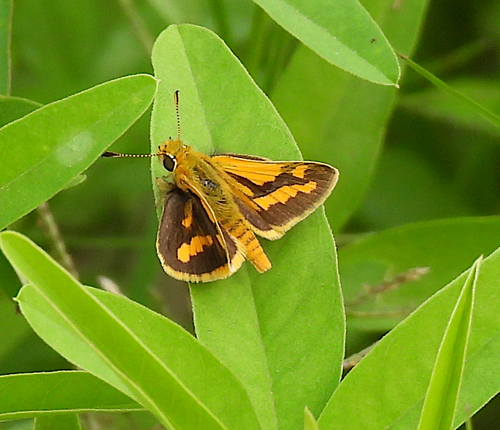
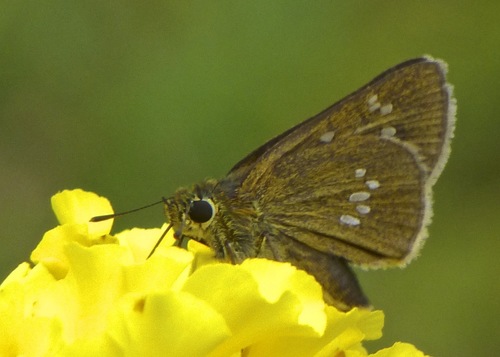
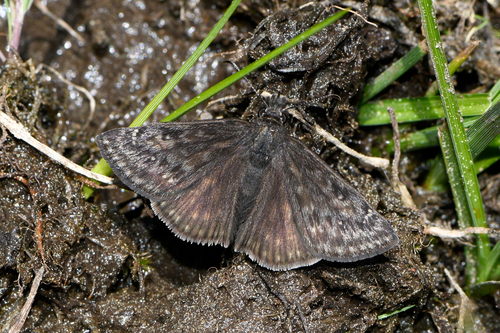
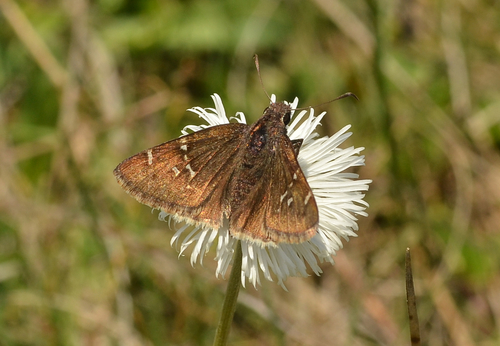
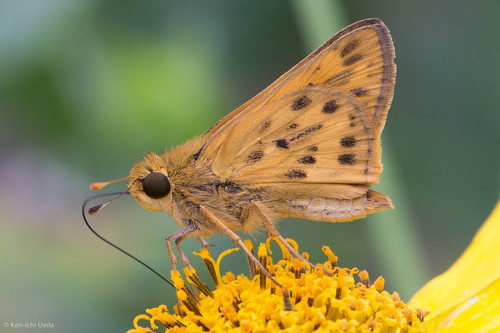
The fiery skipper, Hylephila phyleus, is a butterfly species belonging to the family Hesperiidae. Adult individuals reach approximately 1 inch (2.5 cm) in length. Male fiery skippers are orange or yellow, while females are dark brown. Both sexes have small brown spots on their hindwings and forewings, though the extent of these spots varies between individuals. Females are often a darker brown overall, with pale checkered markings on the hindwing. Fiery skipper larvae, also called caterpillars, are greenish pink-grey with a black head and a constricted neck. These larvae are often considered pests, because they feed on Bermudagrass, creeping bentgrass, and St. Augustine grass. Phylogenetic and genetic analysis of the fiery skipper found that three haplotypes—HphH1, HphH26, and HphH31—are shared among roughly 64.1% of all sampled individuals. Due to this high frequency, these are likely central haplotypes from which other genetic variations arose via mutation. Along with the three central haplotypes, haplotypes HphH22 and HphH23 occur in fiery skipper populations across all continents, with specific haplotypes being more prominent in different regions. Greater haplotype variation is observed in South America, suggesting that South American populations are larger and hold more genetic diversity than North American populations. The fiery skipper has a broad range across North and South America, ranging from Canada in the north to Argentina in the south. In the northern hemisphere, the species may migrate north during the summer to the northern United States and southern Ontario, Canada. Proposed reasons for this northward migration include reproductive competition driven by high population density, reproductive strategy, resource availability, and courtship habits. In 2012, a female fiery skipper was photographed and correctly identified in New Brunswick, Canada, indicating the species occasionally travels as far north as Canada's Maritime Provinces. When searching for mates, male fiery skippers perch on nearby grass or plants and wait for females to enter the area. Males often seek out locations that are most likely to have virgin females, which leads them to patches near or at hatching sites. Courtship is brief, and is frequently disrupted by the presence and competition of rival males. After successful mating, female fiery skippers lay eggs one at a time in separate locations. The eggs are typically small and translucent white when first laid, but turn pale blue within their first few days. Studies of the fiery skipper's reproductive cycle show the mean developmental time from egg to adult is 23.4 to 23.5 days when reared at 27.5–29 °C (81.5–84.2 °F). When first hatched, larvae are green, and later become a duller grey. Larvae at all stages are most distinguishable by their black head and constricted neck; mature larvae reach up to 25 mm (1 in) in length. The pupal stage lasts approximately the same amount of time for both males and females; during this stage, the pupa changes color from green to light brown. Mating takes place shortly after adults emerge from the pupal stage, and adult fiery skippers have an average lifespan of 6 to 11 days. The reproductive habits of fiery skippers were extensively studied by Irene Shapiro, who conducted experiments at the University of California Davis between July and October 1974. Shapiro's study of fiery skipper development in laboratory cultures has helped improve scientific understanding of this species' life cycle.