About Hylaea fasciaria (Linnaeus, 1758)
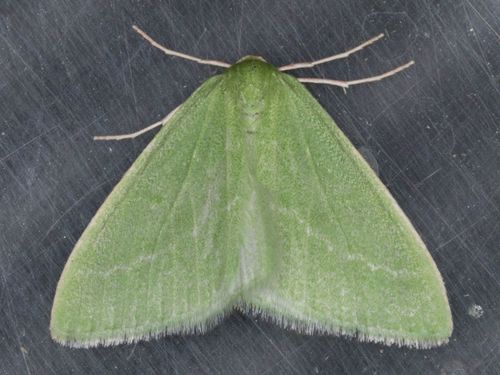
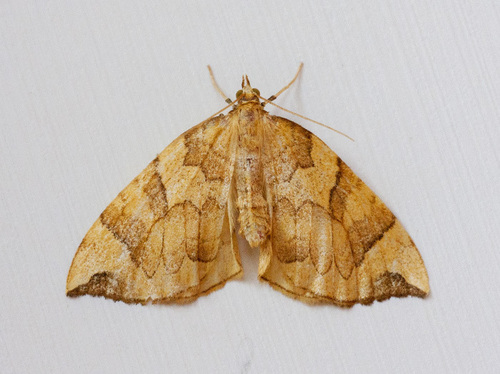
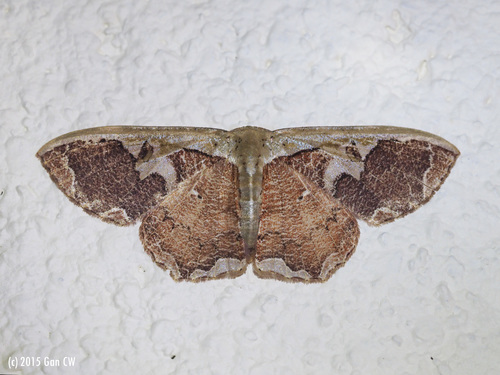
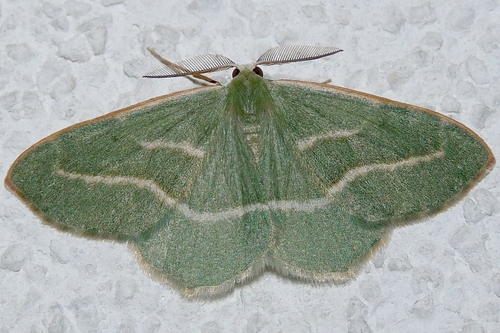
Hylaea fasciaria, commonly called the barred red, is a species of moth belonging to the family Geometridae. This species is distributed across central and northern Europe, the Urals, Caucasus, Altai, and eastern Siberia. Its wingspan measures 27–40 mm. The forma fasciaria has a rust-red leaf-like color, while the forma prasinaria has green wings. Both forms have two slightly irregular, thin, curved transverse bands on their forewings; the central area of the wing enclosed by these bands is usually slightly darker in color. For the rust-red forma fasciaria, these bands are pale whitish. For the green forma prasinaria, the bands range in color from pale whitish to beige to light brown. Additionally, in the green form, the leading edge of the forewing, or costa, is weakly shaded in the same color as the bands. The outer edge of both pairs of wings is fringed with this same band color. The hindwings are usually somewhat lighter in overall color, and have a more or less distinct pale cross line in the second half of the wing. Beyond these two main forms, there are other color variants that display different shades of green or plain brown. Linnaeus described this species twice: first he described a worn, greyish red form, then on the following page he described a brighter red example under the name prosapiaria. Both of these described forms show the two curved lines on the forewing and one curved line on the hindwing. The aberration grisearia Fuchs differs very little from Linnaeus's first described type, but is even greyer. It is frequent in Scotland, and has also been recorded from Germany and Austria. The aberration manitaria H.-Sch. is uniformly dark liver-colored, with its lines completely obliterated. The aberration cinereostrigaria Klem. has dark grey lines instead of white lines. The type specimens, all female, also have narrower wings than typical individuals. The aberration ochreochrearia Joan. (also called ochracearia Rbl.) is a clear ochreous color, nearly matching the color of Ennomos erosaria. The form intermediaria Gmpbg. is a transitional variant: it is green with red coloring on the costal margin, fringes, and the edging of the lines. The form prasinaria Schiff. is an interesting green variant that usually has well-developed white lines, and it is common in some localities. Its larvae feed on pines and spruce fir, while the larvae of the typical fasciaria form feed on Scotch fir. The aberration extiticta Vorbr. Mull-Rutz is a modified variant of prasinaria: it is darker green, with white lines that are almost or entirely gone. The adult moths have two generations per year, flying from April to October. The caterpillars feed on coniferous trees, including Pinus sylvestris and Picea abies.