About Hygrophorus subalpinus A.H.Sm.
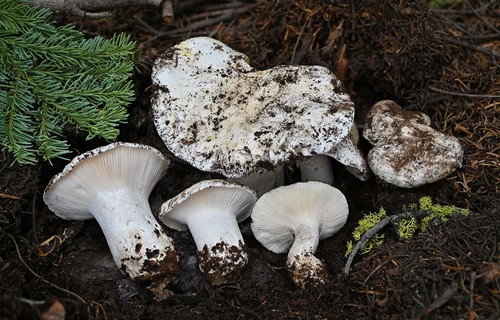
Hygrophorus subalpinus A.H.Sm. has caps 4.5 to 13 cm (1+3⁄4 to 5+1⁄8 in) wide. They start convex, become flattened with age, and sometimes develop a central umbo, a rounded nipple-like elevation. The cap is sticky and white, and its margin often has fragments of the veil adhering to it. The flesh is soft, thick, and white. Gills attach decurrently (running down the length of the stipe), are narrow, closely packed, and white. The stipe is white, measuring 3 to 4 centimetres (1+1⁄8 to 1+5⁄8 in) long and 1 to 2 cm (3⁄8 to 3⁄4 in) thick at the apex. When young, the stipe base is bulbous; as it matures, the base thins to become almost the same width as the stipe apex. A membranous annulus is present low on the stipe. This mushroom has virtually no taste. For microscopic characteristics, spore deposits are white; microscopically, spores are ellipsoid, smooth, and measure 8–10 by 4.5–5 μm. This species has no cystidia on its gills, and clamp connections are present on the hyphae. Fruit bodies of H. subalpinus grow in large clusters under conifers, often near snowbanks, and typically at high elevations such as on mountains. They usually appear after snow in the area has receded, and sometimes grow partly underground. The species is found in North America, ranging from the Rocky Mountains to the Pacific Northwest. Deer eat this mushroom. Hygrophorus subalpinus is reported to be edible, but bland. David Arora notes that it "does not have the greatest texture and flavor". One guide recommends it as a substitute for bamboo shoots.