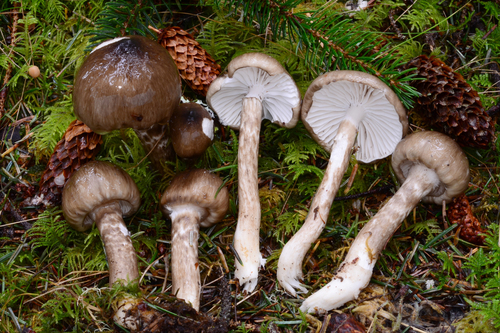
About Hygrophorus olivaceoalbus (Fr.) Fr.
This section covers the microscopic characteristics of Hygrophorus olivaceoalbus (Fr.) Fr. Its spores measure 9–12 by 5–6 μm, are ellipsoid in shape, have a smooth surface, and are non-amyloid. Spores stain yellow when tested with Melzer's reagent. The basidia measure 46–62 by 7–10 μm, are tetrasporic, and bear short, stubby sterigmata. Neither pleurocystidia nor cheilocystidia are present in this species. The cap cuticle is 250 to 450 μm wide, made up of loop-shaped, dark hyphae that are 2 to 3 μm wide. These hyphae form an ixocutis, a horizontal layer of hyphae embedded in slime, and have clamp connections; no hypocutis is present. Gill trama is composed of hyphae that are roughly 3 to 8 μm thick, while cap tissue is made of radial hyphae. H. olivaceoalbus forms ectomycorrhizae as a fungal partner; the well-documented type Piceirhiza gelatinosa is white, with a smooth, waxy surface, and has multiple layers of hyphae wrapped around tree roots. This mycorrhiza sometimes develops hypertrophy. The hyphae are covered in a jelly-like mass secreted from the hyphae’s outer cell walls. The ectomycorrhizae can grow up to 10 mm (3⁄8 in) long, have few side branches, and many older ectomycorrhizae have a hole-like cavity at their tip. For ecology and distribution, Hygrophorus olivaceoalbus forms mycorrhizal associations with conifers. On the West Coast of the United States, it most commonly associates with Sitka spruces and giant redwoods. In the Rocky Mountains, it associates with Engelmann spruce and blue spruce, and in northeast North America it associates with hemlocks. It typically grows best on acidic, chalky ground with mosses, found at higher altitudes in conifer forests, and occasionally in mixed forests. Its fruit bodies are often found growing alone, but may also grow in clusters. The distribution of H. olivaceoalbus covers northern and western North America, Europe excluding the Mediterranean region, and Russia. The fungus usually produces fruit bodies between late summer and early winter; depending on local geography and climate, fruiting may occasionally occur as early as June or continue through December. The global population is not currently endangered, with the only exception being France, where the species is almost extinct.