About Hygrophorus marzuolus (Fr.) Bres.
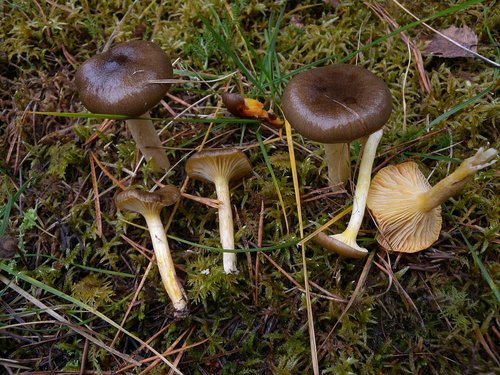
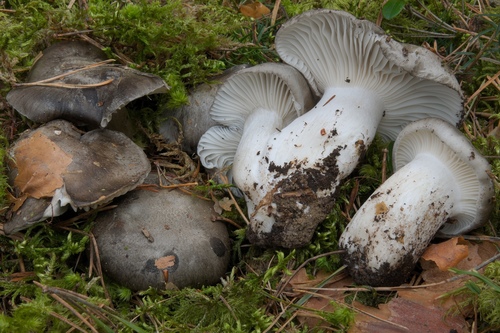
Fruit bodies of Hygrophorus marzuolus have broadly convex caps 2.5–11 cm (1.0–4.3 in) in diameter. Cap surfaces are smooth and sticky, with a pale greyish-brown center and a darker brown to blackish-grey margin. The gills are distantly spaced, broad, with an adnate to adnexed attachment to the stipe, and feature two tiers of short intervening gills called lamellulae. Gills are initially white, turning gray to bluish-gray as they age. The whitish stipe is 3–10 cm (1.2–3.9 in) long and 1–2.5 cm (0.4–1.0 in) thick, and is either equal in width along its length or tapers slightly toward the base. The stipe is smooth, with only a few tufts of hairs near its top. Directly beneath the cap cuticle, the cap flesh is water-soaked; other areas of the cap flesh are gray-tinted with a sheen, while the stipe flesh is dull white. The fungus has no noticeable odor or taste. It is considered edible in Europe, and is prized in some European regions. Its thin-walled, elliptical spores measure 6.5–8.5 by 4.5–5 μm. The spore-bearing basidia are narrowly club-shaped, four-spored, and measure 42–55 by 5.4–8.1 μm. Hygrophorus marzuolus is a mycorrhizal fungus. It has been recorded forming mycorrhizal associations with Abies alba, and sometimes with Picea excelsa and Pinus sylvestris. Fruit bodies grow singly, scattered, or sometimes in clusters on the forest floor, in duff or moss. It fruits under conifers, most often fir and Engelmann spruce, and typically grows at high elevations. It is a snowbank mushroom that associates with melting snow, and its fruiting begins under snowbanks. This fungus has been recorded from the mountains of Idaho, Montana, Oregon, Washington, northern Arizona, and northern California in North America. In Europe, its distribution ranges from the French Pyrenees to the Prague region. It has also been reported from Pakistan in Asia.