About Hygrophorus eburneus (Bull.) Fr.
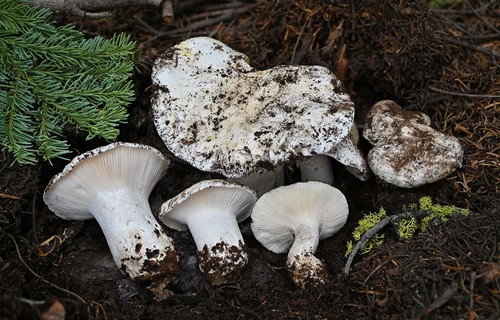
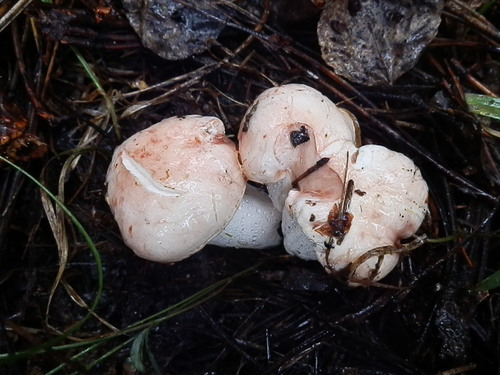
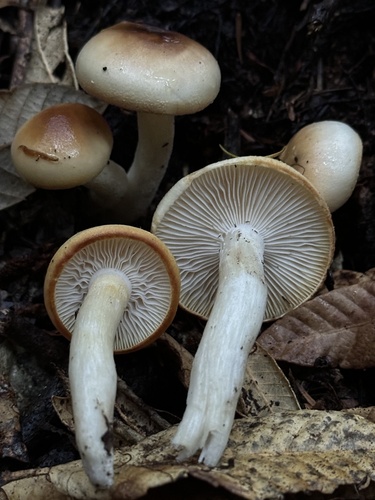
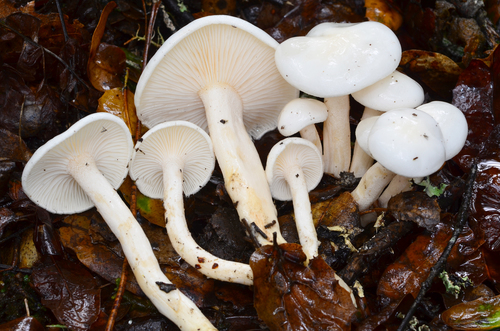
This fungus is Hygrophorus eburneus (Bull.) Fr. Its cap is 2 to 7 cm (0.8 to 2.8 in) wide, ranging in shape from convex to flattened, and it sometimes has an umbo, a raised area at the cap's center. As the mushroom ages, the cap margin sometimes becomes elevated, and the center of the cap becomes depressed. The cap is pure white, and may be glutinous to sticky depending on environmental moisture levels. The cap surface is smooth, the margin is even; in young specimens, the margin is rolled inward and covered with short fibrils. The flesh is soft and white, thick at the cap center and thinning toward the margin. Both odor and taste are mild. The gills are somewhat arcuate-decurrent: shaped like a bow, curving upward before running down the stem for a short distance. They are spaced from subdistant to distant, meaning visible gaps exist between individual gills. The gills are moderately broad, widest near the stem, narrowed toward the front, and pure white, turning slightly yellowish or buff with age or when dried. The stem is 4 to 15 cm (1.6 to 5.9 in) long, 0.2 to 1.5 cm (0.08 to 0.6 in) thick. It is equal in width along its length, may taper somewhat downward, or have a greatly attenuated base, and it is glutinous. Its surface is silky underneath the gluten layer. The top of the stem is covered with short fibrils, and is pure white, sometimes turning grayish or soiled with age. It is initially filled with cotton-like mycelia, and becomes hollow as it matures. Dried fruit bodies typically retain their white cap color, while stems dry darker, especially if the fresh stem was initially waterlogged. For microscopic characteristics: spores appear white when viewed in mass, such as in a spore print. Light microscope observation shows spores are ellipsoid, smooth, and measure 6–8 by 3.5–5 μm. They stain pale yellow in Melzer's reagent. The spore-bearing basidia measure 42–52 by 6–8 μm, and are four-spored. There are no pleurocystidia or cheilocystidia. Gill tissue is made of branching hyphae about 7–12 μm wide. The cap cuticle is made of gelatinous, narrow (3–6 μm) repent (bent over) hyphae that typically have some erect free ends. Clamp connections are present in the hyphae. Fruit bodies of Hygrophorus eburneus grow on soil, most commonly in coniferous woods, thickets, and grassy areas. The fungus prefers moist, mesic, loamy, calcareous soil. It is widely distributed across North America, and is also found in Europe (Poland and Portugal), Israel, and North Africa. The mushroom is edible, though many people find it unappealing due to its sliminess. In China, a yak milk beverage is produced from Hygrophorus eburneus and yak milk via lactic acid fermentation, using a mixed starter of Lactobacillus bulgaricus, Streptococcus thermophilus, and Lactobacillus acidophilus.