About Hygrophorus caeruleus O.K.Mill.
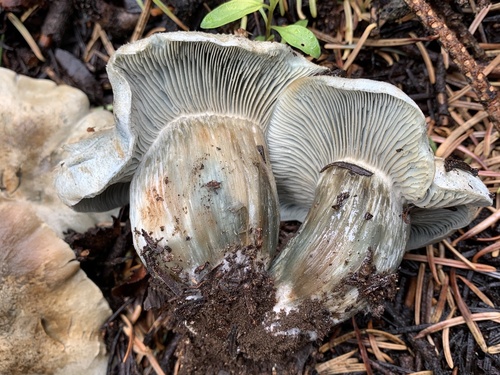
The fruit bodies of Hygrophorus caeruleus have broadly convex caps 5–9 cm (2.0–3.5 in) in diameter. Caps are cream-colored with a blue tint, most prominent around the margin. The cap surface is felt-like, moist, and covered with a coarse network of cracks and small crevices. The gills are bluish-green to gray, with spacing that ranges from close to somewhat distant, and attach to the stipe in an adnate to slightly decurrent arrangement. Two tiers of short gills called lamellulae are interspersed between the full-length gills. Like most Hygrophorus species, crushed gills of H. caeruleus have a waxy texture. The stipe is 2.5–5 cm (1.0–2.0 in) long, 1.5–2.5 cm (0.6–1.0 in) thick, and tapers abruptly at its base. It is usually somewhat twisted, with a surface made of longitudinally arranged, flattened fibrils. Its color runs from bluish-green to cream toward the base; the upper portion is somewhat pruinose, meaning it is covered in a fine dusting of white powder. The base of the stipe attaches to fine white rhizomorphs. The flesh is dingy cream, and bruises to a fading bluish-gray to blue-green when injured. It has a strong odor of rancid meal. The spore print is white. Spores are elliptical, thin-walled, and hyaline, measuring 2.5–5 μm. The four-spored spore-bearing basidia measure 35–45 by 7–8 μm. Fruit bodies of this rare fungus grow in scattered groups under Douglas fir, Grand Fir, and Engelmann spruce, typically growing partially buried in the forest floor. It has been reported from the US states of Idaho, Oregon, and Washington.