About Hygrocybe punicea (Fr.) P.Kumm.
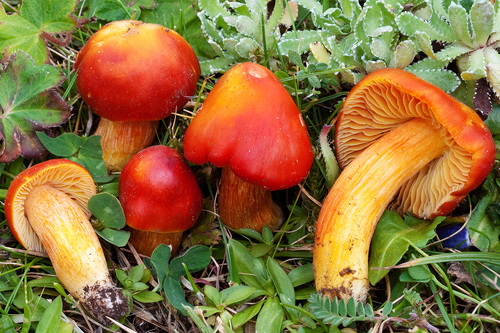
Basidiocarps of Hygrocybe punicea are agaricoid, growing up to 15 centimetres (6 in) tall. The cap is convex to broadly umbonate, becoming flat with age, and reaches up to 15 cm across. The cap surface is smooth, greasy to viscid, and colored dull dark red to crimson, becoming pale yellow to buff in some areas when dry. The gills (lamellae) are waxy, dark red to buff with purple tints and have yellowish margins. The stipe (stem) is smooth but fibrillose and streaky, yellow to orange-red, whitish towards its base, and lacks a ring. The spore print is white; under a microscope, the spores are smooth, inamyloid, ellipsoid, and measure approximately 8.5 to 10 by 4.5 to 5.5 μm. This species is widespread but generally rare throughout Europe. Like most other European waxcaps, it grows in old, agriculturally unimproved, short-sward grassland such as pastures and lawns. Existing records from East Asia, North America, where it is called the scarlet waxy cap and reported to occur in woodland, and Australia need further research to confirm whether these collections represent the same species. Recent research indicates that waxcaps are neither mycorrhizal nor saprotrophic, and they may be associated with mosses. Though it is sometimes claimed to be edible, Hygrocybe punicea accumulates cadmium, and consumption causes poisoning.