About Hygrocybe miniata (Fr.) P.Kumm.
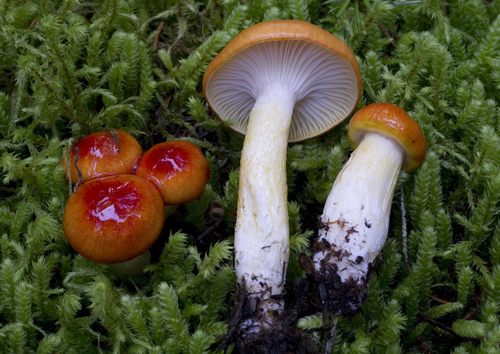
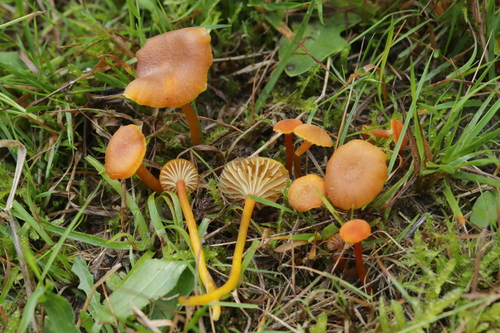
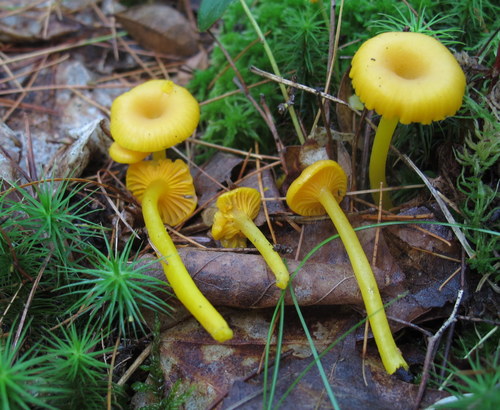
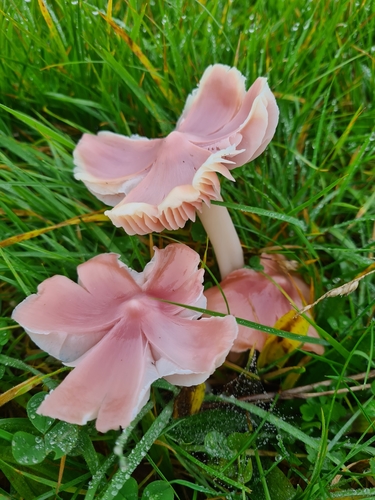
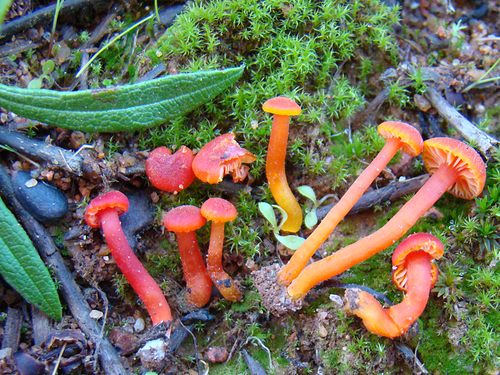
Description: The cap of Hygrocybe miniata ranges in color from red to yellow. It starts out convex, and later flattens and becomes depressed with wavy edges. It is hygrophanous, and has small scales that are visible with a magnifying glass. The center of mature fruiting bodies is noticeably scurfy (scaly), and this feature is most visible on dry, unrained-on specimens. The cap is scarlet-orange with a yellow striate margin, and measures 0.5–3.5 cm in diameter. The bare stem is often long, reaching up to 3 times the diameter of the cap, tapers towards the base, and tends to flatten. It matches the cap's color or is slightly paler, and has a white base. The gills are orange, with a broad adnate attachment to the stem or are slightly decurrent. They are widely spaced and somewhat notched. The flesh is orange, and has no distinctive odor. The spore print is white, and the ellipsoid spores measure 7–9 x 4–5 μm. Distribution and habitat: Hygrocybe miniata is a cosmopolitan species that has been recorded across most temperate zones. It has been collected from Britain, Europe, eastern North America, and matching temperate zones in the Southern Hemisphere including eastern and southern Australia, where it has been documented in Queensland, New South Wales, Victoria and Tasmania. In Britain, it fruits in autumn, especially during frost-free periods, and prefers sandy heaths, grassy clearings, or unimproved fields. It is often found growing alongside mouse-ear hawkweed (Hieracium pilosella). In Australia, it occurs in temperate to subtropical rainforest, eucalypt forest, and heathland. Fruiting bodies can grow in groups among leaf litter from January to June.