About Hygrocybe conica (Schaeff.) P.Kumm.
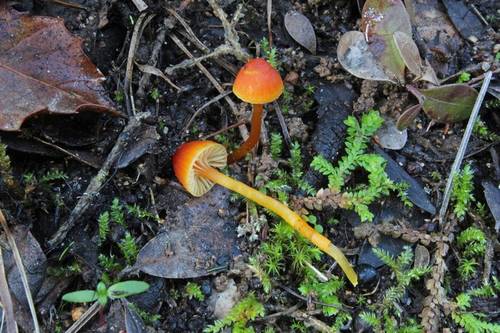
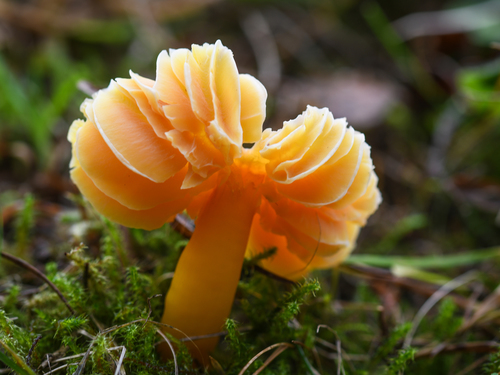
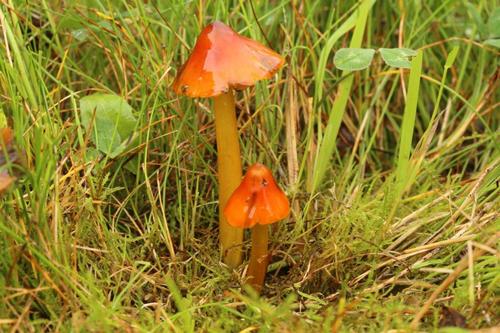
Basidiocarps of Hygrocybe conica are agaricoid. The cap is narrowly conical when young, later becoming umbonate and often lobed, and can grow up to 10 centimetres (4 in) across. The cap surface is smooth and finely fibrillose, moist or viscid when young, and ranges in color from yellow to orange or scarlet. The lamellae (gills) are waxy, and colored white to pale yellow or greyish. The stipe (stem) grows up to 20 cm (8 in) long, is smooth but fibrillose and streaky, yellow to orange-red, whitish towards its base, and lacks a ring. All parts of the mushroom become duller and grey as they age, and finally turn entirely black. The flesh is yellowish and stains black when cut or bruised. The spore print is white; under a microscope, spores are smooth, inamyloid, ellipsoid, and measure approximately 8.5 to 11.5 by 5 to 7.5 μm. A number of other species within the Hygrocybe genus can appear similar to this species. Hygrocybe conica is widely distributed across North America, Europe, Asia, Australia, and New Zealand, and is found in summer and autumn. In Europe, it is typically found in waxcap grasslands, a declining habitat caused by changing agricultural practices. It is one of the most common waxcap species, and can also be found in dunes, road verges, and other habitats. In North America, it is often found in conifer woodland. While H. conica does occur in Australia, principally near urban areas, many collections originally identified as this species are actually the similar species H. astatogala.