About Hygrocybe citrinovirens (J.E.Lange) Jul.Schäff.
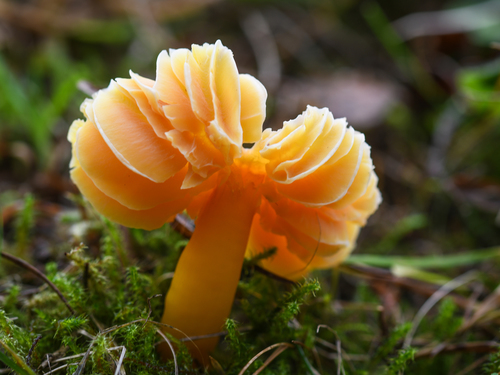
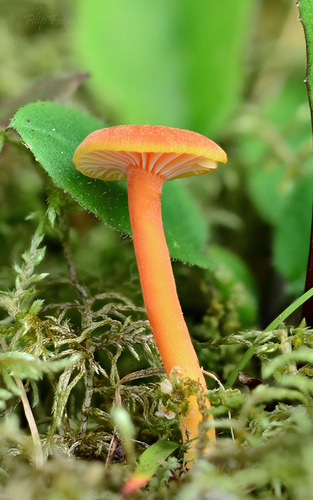
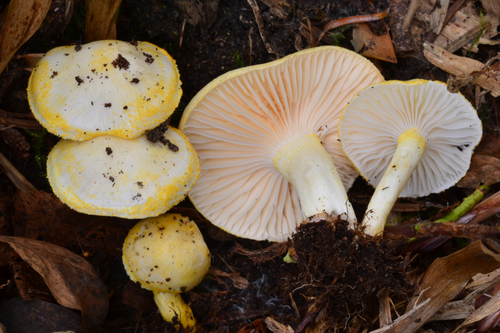
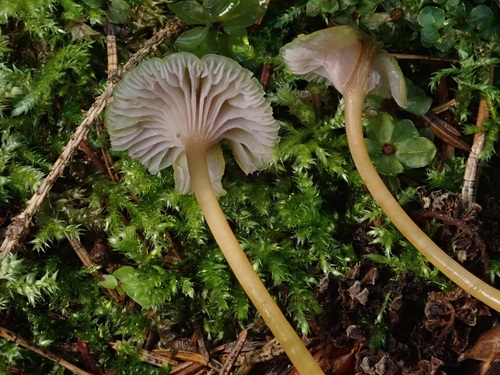
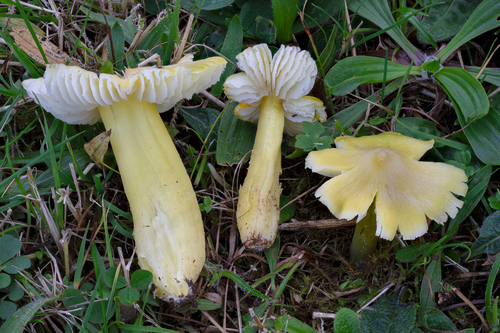
This species has agaricoid basidiocarps that grow up to 130 mm (5 in) tall. The cap is conical when young, and retains an acute or distinct umbo after expanding; it reaches up to 90 mm (3 in) across, and often splits at the margins. The cap surface is smooth, dry, and radially fibrillose, with a color ranging from greenish yellow to lemon-yellow. The gills (lamellae) are waxy, and range in color from white to a pale version of the cap color. The stem (stipe) is smooth, often compressed, grooved, or splitting, matches the pale cap color, and has no ring. The spore print is white, and individual spores are smooth, inamyloid, and ellipsoid under a microscope, measuring approximately 6.5 to 8.5 by 5 to 6 μm. Commonly called the Citrine Waxcap, this species is widespread but generally rare across Europe, with its largest populations found in the northwest of the continent. Like other waxcaps, it grows in old, agriculturally unimproved, short-sward grassland such as pastures and lawns. In North America, the rare species Hygrocybe virescens resembles H. citrinovirens, but has a more distinctly green color. Recent research indicates that waxcaps are neither mycorrhizal nor saprotrophic, and may be associated with mosses.