About Hygrocybe aurantiosplendens R.Haller Aar.
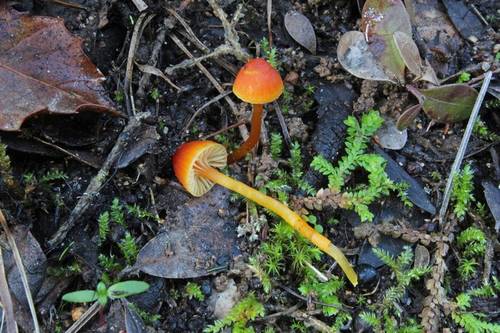
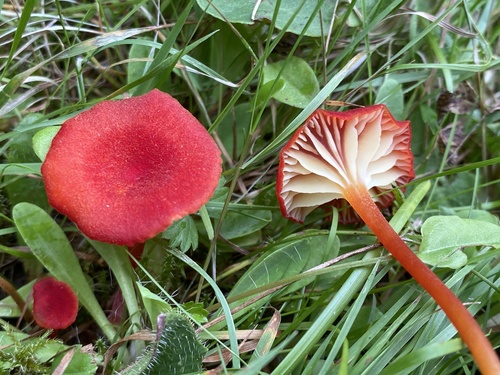
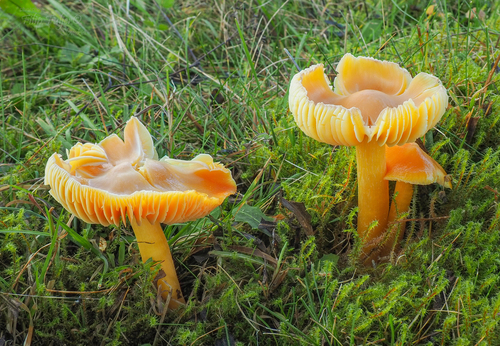
Basidiocarps of Hygrocybe aurantiosplendens are agaricoid. The cap starts broadly conical, maturing to a broadly umbonate shape; it is yellow-orange to orange-red, turning yellow as it ages, measures 2 to 5 cm (1 to 2 in) across, has a smooth texture, is waxy to viscid when wet, and has translucent margins. The lamellae (gills) match the cap color or are paler, and are narrowly adnate. The stipe (stem) is yellow with a white base, sometimes tapering away from the base, lacks a ring, and measures 3 to 9 cm (1.5 to 3.5 in) long by 0.5 to 1 cm (0.2 to 0.4 in) thick. Microscopically, the spores measure 7.5 to 9 by 4 to 5 μm, are ellipsoid to oblong, often constricted in the middle, smooth, and inamyloid; 4-spored basidia reach up to 60 μm in length. There is no distinct smell or taste. Like most other European Hygrocybe species, the orange waxcap typically grows in old, nutrient-poor, short-sward grassland such as pastures and lawns. While Hygrocybe species were previously thought to be saprotrophic, new evidence indicates they form a biotrophic or symbiotic association with moss. Hygrocybe aurantiosplendens is widespread across Europe but is rare to uncommon across its entire range. The British Isles and Scandinavia hold the greatest abundance of H. aurantiosplendens, but it is also found in Finland, Iceland, Western Russia, and at high elevations in Southern Europe. American populations classified as "H. aurantiosplendens" are more typically found in woodlands. In Eastern North America, its range extends sporadically from Maine south to Florida and west to Northern Wisconsin. On the West Coast of North America, it is largely restricted to coastal regions from Northern Washington to Central California, though this western taxon may be distinct enough to be classified as a separate species.