About Hydrurga leptonyx (de Blainville, 1820)
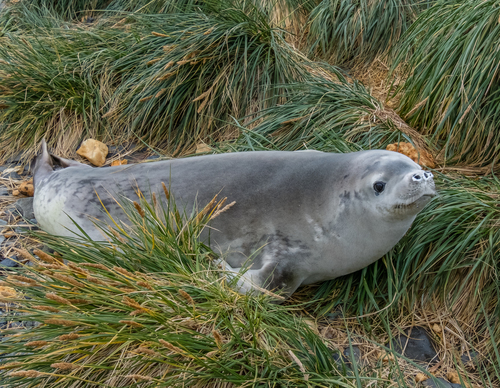
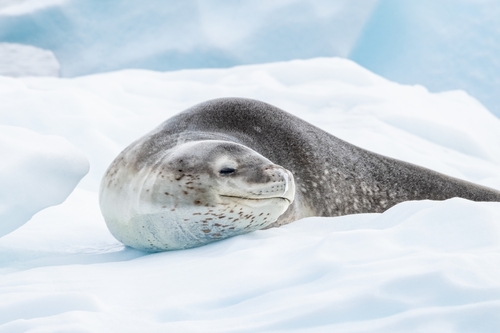
The leopard seal (Hydrurga leptonyx, first described by de Blainville in 1820) has a distinctly long, muscular body compared to other seals. Adult leopard seals measure 2.4–3.5 m (7.9–11.5 ft) in overall length, and weigh between 200 and 600 kilograms (440 to 1,320 lb). They are the same length as the northern walrus, but usually weigh less than half as much. A thick layer of blubber covers their body; this blubber keeps them warm in the cold temperatures of the Antarctic, and also streamlines their body to make them more hydrodynamic, helping them hunt swift prey. Blubber thickness, along with general girth, weight, and length measurements can be used to determine a leopard seal's body condition. Leopard seals are sexually dimorphic: females are up to 50% larger than males. In the wild, leopard seals can live up to 26 years. The species is best known for its massive jaws, which allow it to be one of the top predators in its habitat. A leopard seal's canine teeth can grow up to 2.5 cm (1 in) long. Its canines and incisors are sharp, similar to those of other carnivores, but its molars lock together in a shape that lets the seal sieve krill from water. This trait is shared with other species in the tribe Lobodontini, such as the crabeater seal, and it is the characteristic that gives the tribe its name. As true seals in the family Phocidae, leopard seals have no external ears or pinnae, but they do have an internal ear canal that opens to an external opening on the head. Their hearing in air is similar to that of humans, but scientists have observed that leopard seals use their ears together with their whiskers to track prey underwater. The whiskers of leopard seals are short and clear. Compared to other phocids, leopard seals have extremely large front flippers. These large front flippers are used to steer through the water, making the seals extremely agile when hunting. Leopard seals use their front flippers in a similar way to sea lions of the family Otariidae. Leopard seal fur is counter-shaded: it is mostly a blend of silver and dark gray, with a distinctive spotted, leopard-like pattern on the back (dorsum), and a white to light gray color on the underside (ventrum). Leopard seals are pagophilic, or ice-loving, seals that primarily live on Antarctic pack ice between 50˚S and 80˚S. Higher densities of leopard seals are found in West Antarctica than in other regions. Most leopard seals stay within the pack ice year-round, and live solitary lives for most of the time. The only exception is a mother and her newborn pup. These mother-pup groups may travel further north in the austral winter to sub-Antarctic islands and the coastlines of southern continents to care for their pups. While solitary leopard seals may appear in lower latitude areas, females rarely breed in these locations. Some researchers think this is due to safety concerns for the pups. The estimated total population of leopard seals ranges from 220,000 to 440,000 individuals, so the species is classified as Least Concern. Even though leopard seals are abundant in Antarctica, they are hard to survey using traditional audiovisual techniques. This is because they spend long periods vocalizing under the water's surface during the austral spring and summer, which is when audiovisual surveys are typically conducted. Their habit of underwater vocalizing makes leopard seals naturally suited for acoustic surveys, the same method used for cetaceans, and most current knowledge of the species has been gathered through this approach. Vagrant leopard seals have been sighted on the coasts of Geraldton, Western Australia, at multiple sites in New Zealand, along the coasts of South America, and on the coast of South Africa. Fossil evidence shows that leopard seals were present in South Africa during the Late Pleistocene.