About Hydrocotyle bonariensis Comm. ex Lam.
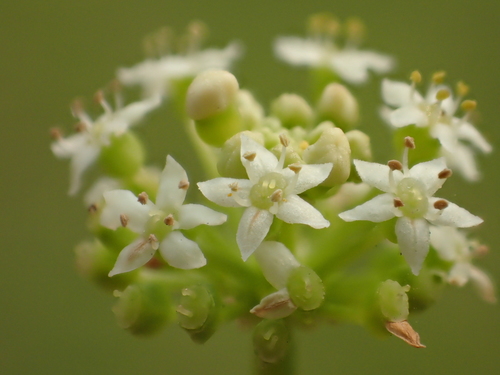
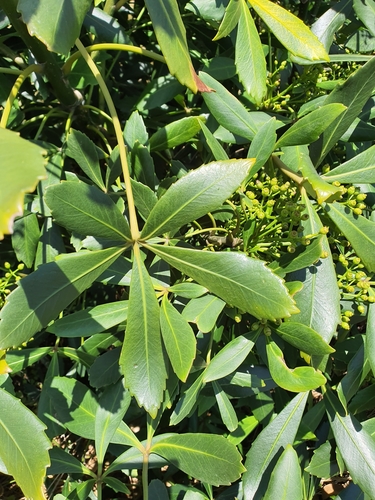
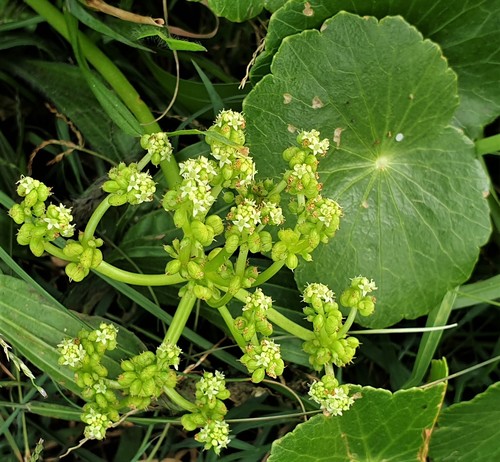
Hydrocotyle bonariensis Comm. ex Lam. produces numerous white to creamy-yellow flowers, held on flower stalks that reach up to 30 centimetres (12 in) in height. This species has creeping stems that root at their nodes, and it spreads through rhizomes. It forms a dry dehiscent fruit, which splits at maturity into two or more parts, each holding one single seed. It is commonly referred to as Dollar Weed. This plant grows in sandy habitats with relatively extreme conditions, occupying areas that are very dry but also experience occasional flooding. Its associated community species include Ipomoea pes-caprae, Senecio crassiflorus, and Juncus acutus. Its co-dominant species are Imperata brasiliensis and Bacopa monnieri. This species colonizes sandy ground, disturbed foreshore sites, estuaries, coastlines, sand dunes, and ponds. It shows a preference for and grows more strongly at higher elevations. This species is native to multiple regions across the world: in Afrotropic, it is native to West-Central Tropical Africa (Cameroon), West Tropical Africa (Côte d'Ivoire, Ghana, Liberia, Nigeria, Senegal), South Tropical Africa (Angola, Mozambique), Southern Africa (South Africa), and the Western Indian Ocean (Madagascar, Mauritius, Réunion). In the Nearctic, it is native to the Southeastern United States (Alabama, Florida, Georgia, Louisiana, Mississippi, North Carolina, South Carolina) and South-Central United States (Texas). In the Neotropic, it is native to Central America (Costa Rica, Guatemala, Nicaragua, Panama), the Caribbean (Cuba, Puerto Rico), Northern South America (Venezuela), Brazil (Brazil), Western South America (Bolivia, Colombia, Peru), and Southern South America (Argentina, Chile, Paraguay, Uruguay).