About Hydrocharis laevigata (Humb. & Bonpl. ex Willd.) Byng & Christenh.
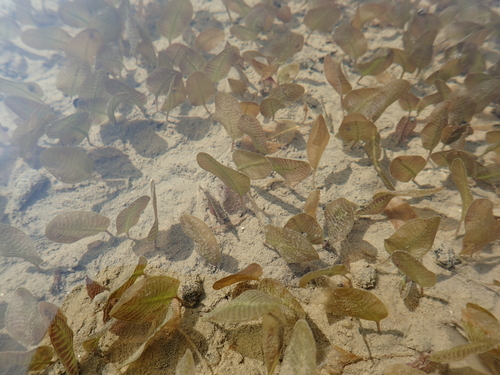
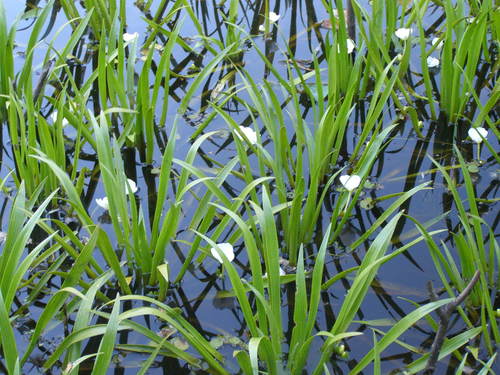
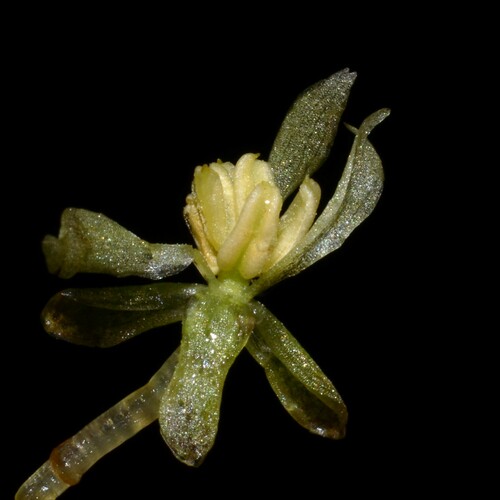
Hydrocharis laevigata (common names Smooth Frogbit, Spongeplant, Amazon Frogbit) is a floating aquatic plant that is often confused with water hyacinth (Eichornia crassipes) due to superficial similarities in appearance. Juvenile plants grow as rosettes of floating leaves that lie prostrate on the water surface; a distinguishing feature of juvenile plants is spongy aerenchyma tissue on the abaxial (underside) of the leaf. Mature plants can grow up to 50 cm tall, and produce emergent leaves attached to petioles that are not swollen or inflated, unlike the spongy buoyant leaf stalks of water hyacinth. Spongeplant produces stolons that bear gametes. Its flowers are small, white, and unisexual; female flowers have an inferior ovary. The fruit is a fleshy capsule that measures 4–13 mm long and 2–5 mm in diameter, and the seeds are 1 mm long, ellipsoid, and hairy. H. laevigata can be told apart from H. spongia, American frogbit, by flower and leaf characteristics as well as geographic range. Flower morphology of both species varies widely across their ranges. Unlike smooth frogbit, American frogbit is not known to occur in the western United States. American frogbit generally has floating leaves with more cordate bases, while smooth frogbit generally has more spatulate floating leaves. Spongeplant is native to freshwater habitats in tropical and subtropical Mexico, Central America, the Caribbean, and South America. It has been introduced to other regions across the globe, including California, France, Spain, Sweden, Poland, Japan, western and eastern Australia, Zambia, Zimbabwe, and Java. In California, it was introduced as an ornamental pond plant and has escaped into larger waterways, including areas surrounding Redding and Arcata, the Sacramento River delta, the San Joaquin River, ponds, and irrigation canals. It is an invasive species in Chile, where it has been recorded from the Elqui River in the north to Carlos Anwandter Nature Sanctuary and Ranco Lake in the south. Hydrocharis laevigata can reproduce and spread both sexually via flower pollination and seed production, and vegetatively via fragmentation of stolon segments. Juvenile plants have high dispersal capacity: they are small, float, and can be carried quickly and easily by moving water currents. In captivity, Amazon Frogbit is used in aquascapes, and aquarium owners can avoid two common hazards to the plant's health: first, water droplets resting on top of the leaves can cause the plant to rot, so leaf tops must be kept dry; second, some species of aquatic snail feed on the spongy tissue on the undersides of the plant's leaves, so the plants should be kept near the center of the tank rather than against the glass edges.