About Hydrictis maculicollis (Lichtenstein, 1835)
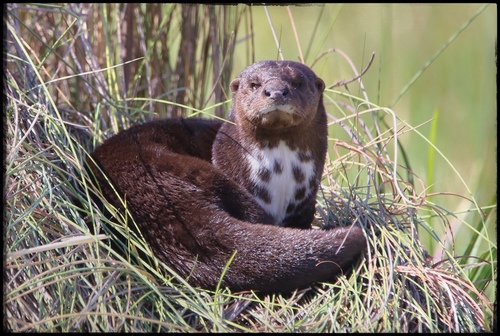
The spotted-necked otter, Hydrictis maculicollis, typically has a chocolate to reddish brown coat with creamy or white blotches across the chest and throat. It has a broad head, a short muzzle, small rounded ears, and a hairless nose pad. Its teeth are specifically adapted for eating fish: it has large sharp upper canines, curved lower canines, and sharp carnassial teeth. Its jaw structure is also adapted for this diet; the mandibular fossa fits so tightly around the lower jaw condyle that the lower jaw cannot move sideways, which makes it easier to capture and hold fish. This is a relatively small otter species. Males measure 71 to 76 cm (28 to 30 in) from nose to rump and weigh 5.7 to 6.5 kg (13 to 14 lb), while females measure 57 to 61 cm (22 to 24 in) and weigh 3.0 to 4.7 kg (6.6 to 10.4 lb). The long, muscular tail measures 39 to 44 cm (15 to 17 in) in both sexes. The species has a sleek coat and webbed paws. Females have two pairs of teats. Males have a large scrotum, but their penis is hidden beneath the skin to reduce drag while swimming. Up to five subspecies were previously recognized, but these are now thought to represent natural variation in appearance between individuals, so no subspecies are currently accepted. Spotted-necked otters inhabit lakes and larger rivers across most of Africa south of 10°N. They are common in Lake Victoria and throughout Zambia, but are not found in the Zambezi below Victoria Falls, Zambia. They never enter salt water. The spotted-necked otter is highly vocal, producing high, thin whistles and rapid, shrill chatters. It sometimes lives in family groups, but is only social under specific conditions. Males and females live separately for at least part of the year. They usually hunt alone, except when mothers are training their young, and they are not territorial. They shelter overnight in short burrows, rock crevices, or patches of dense vegetation. On land, they mostly travel along regular paths, and rarely move more than 10 m (33 ft) from the banks of rivers or lakes. Both sexes mark these paths with established "sprainting" sites where they repeatedly defecate and urinate. The spotted-necked otter is diurnal, and hunts entirely by sight using short dives that last less than 20 seconds each, in clear water with good visibility. It carries larger prey ashore to eat, but consumes smaller prey while treading water. Its diet consists primarily of fish, typically less than 20 cm (7.9 in) long, but it also eats frogs and small crustaceans, especially when fish is scarce. After a gestation period of around two months, females give birth to litters of up to three young. Young spotted-necked otters are born blind and helpless, and mothers care for their young for almost a full year. Confirmed predators of the spotted-necked otter include lions, crocodiles, and African fish eagles.