About Hydrelia flammeolaria (Hufnagel, 1767)
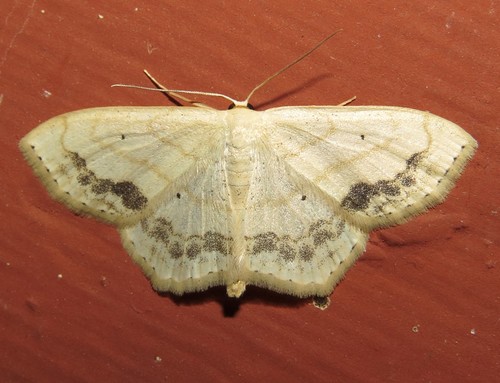
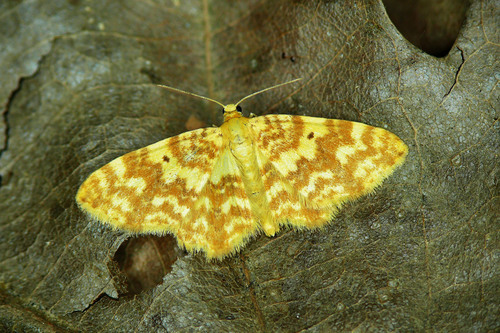
Hydrelia flammeolaria, commonly called the small yellow wave, is a moth species belonging to the family Geometridae. Johann Siegfried Hufnagel first described this species in 1767. It can be found across most of the Palearctic realm, ranging from western Europe all the way to Japan. The wingspan of adults measures 14 to 20 mm. This species looks similar to Asthena albulata, but can be told apart by two key traits. In Hydrelia flammeolaria, the brown-yellow areas of the wings are roughly the same size as the white areas, while white color dominates the wings of Asthena albulata. Additionally, the forewing of Hydrelia flammeolaria has a small brown spot. The forewings of Hydrelia flammeolaria are white, marked with around six fairly wide, wavy brownish-yellow cross-bands that sometimes partially flow into one another. A small brown spot sits in the middle of the forewing. The hindwings are white, with three brownish-yellow cross-bands. The larva of this species is light green, with white longitudinal stripes running along either side of its back. The species produces one new generation per year. Adult moths are active in flight from mid-May to August. The larvae feed on a variety of deciduous tree species, including species in the Alnus genus, specifically Alnus glutinosa and Alnus incana, and species in the Acer genus, specifically Acer campestris. Larvae can be found from July to September. This species overwinters in its pupal stage.