About Hyalosperma demissum (A.Gray) Paul G.Wilson
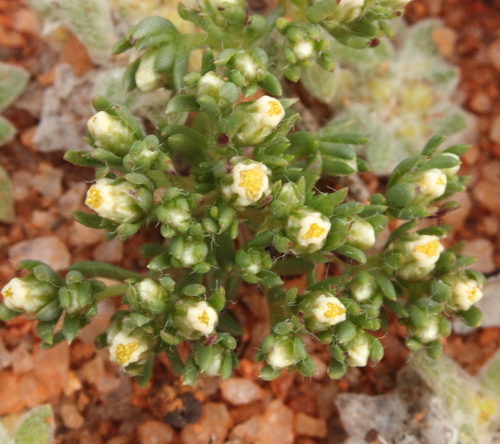
Hyalosperma demissum, commonly called moss-sunray, is a small, rounded annual plant that reaches 5–20 mm (0.20–0.79 in) in height. Plants are either sparsely covered with long, soft, straight hairs, or completely smooth. Its leaves are linear and roughly triangular in cross-section, measuring about 5 mm (0.20 in) long and about 0.2 mm (0.0079 in) wide, and taper gradually to a sharp point. Its whitish-yellow flowers form dense clusters nestled among the plant's foliage. The flower bracts are arranged in 3 to 4 rows, and are broadly oblong to oval in shape. The outer bracts are 2–2.5 mm (0.079–0.098 in) long, nearly translucent, and can be colored light green, silvery, or light yellowish brown. Flower clusters contain 15 to 25 individual florets, and the floret corolla has 3 or 4 lobes. Flowering takes place between September and December. The fruit produced is a dry, single-seeded structure that is compressed, egg-shaped, warty, and approximately 0.7 mm (0.028 in) long. This species grows on clay, loam, sand plains, shallow rocky soils, and winter-wet sites. It can be found in Western Australia, Tasmania, New South Wales, Victoria, and South Australia.