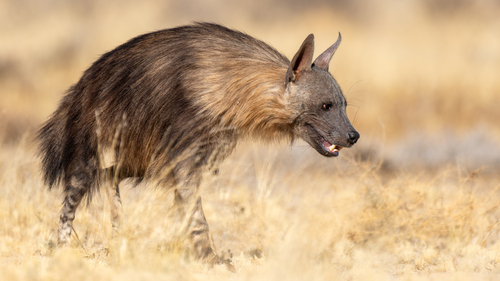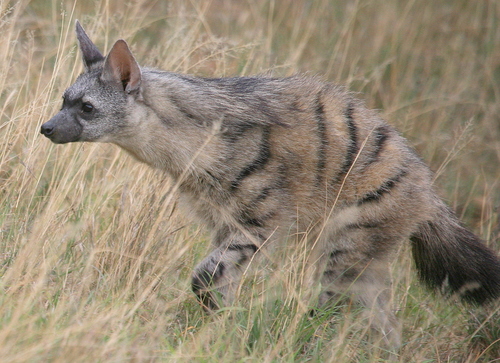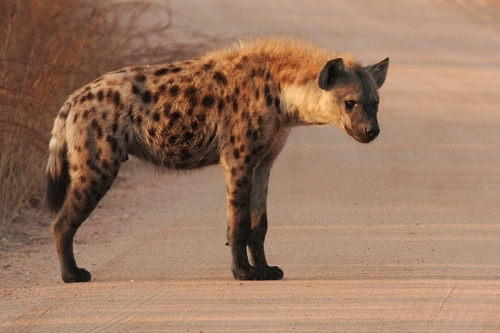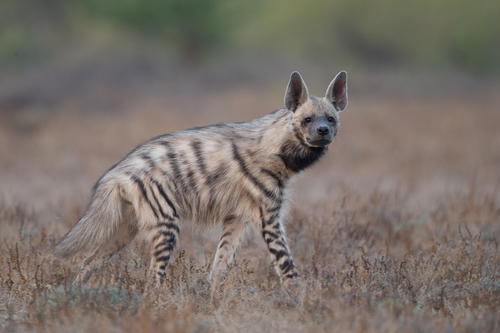
About Hyaena hyaena (Linnaeus, 1758)
Taxonomy and Nomenclature
The striped hyena (Hyaena hyaena) is a hyena species native to North and East Africa, the Middle East, the Caucasus, Central Asia, and the Indian subcontinent. It is the only living species in the genus Hyaena.
Conservation Status
It is classified as Near Threatened by the IUCN, with an estimated global population of fewer than 10,000 mature individuals. The population continues to face both intentional and accidental persecution, alongside a shrinking prey base, which is projected to lead to a total decline of close to 10% over the next three generations.
Morphological Traits
It is the smallest of the bone-cracking hyena species, and retains many primitive characteristics similar to viverrids that larger hyena species have lost. It has a smaller, less specialized skull.
Feeding Behavior
While it is primarily a scavenger, large individuals have been recorded killing their own prey, and very rare attacks on humans have happened.
Reproductive System
The striped hyena is monogamous; both males and females work together to raise their cubs.
Activity Pattern
It is a nocturnal animal that usually only emerges after full darkness sets in, and quickly returns to its lair before sunrise.
Predator Interactions
Despite its habit of feigning death when attacked, it has been observed standing its ground against larger predators during disputes over food.
Cultural Significance
The striped hyena holds a prominent place in Middle Eastern and Asian folklore. In some regions, its body parts are thought to have magical properties and are used as charms or talismans.
Religious and Historical References
It is referenced in the Hebrew Bible, where it is called tzebua or zevoa, though it does not appear in some English translations of the Bible. The Ancient Greeks referred to it as γλάνος (glános) and ύαινα (húaina), and were familiar with the species from the Aegean coast of Asia Minor. It is also the national animal of Lebanon.
Subspecies and Geographic Variation
As of 2005, no subspecies of the striped hyena are formally recognized, but the species does show geographic variation across its range.
Arabian Peninsula Morphology
Striped hyenas from the Arabian Peninsula have a prominent dark black dorsal mane, with mid-dorsal hairs growing up to 20 cm long. Their base fur color ranges from grey to whitish grey, with dusky grey muzzles and buff yellow fur below the eyes.
Israel Population Morphology
Striped hyenas in Israel have a dorsal crest that is a mix of grey and black, rather than being mostly black.
Size Variation by Region
The largest striped hyenas come from the Middle East, Asia Minor, Central Asia, and the Indian subcontinent, while individuals from East Africa and the Arabian Peninsula are smaller.
Historical Distribution
Historically, the striped hyena’s range covered all of Africa north of and including the Sahel zone, eastern Africa extending south into Tanzania, the Arabian Peninsula, the Middle East as far north as the Mediterranean Sea, Turkey, Iraq, the Caucasus (Azerbaijan, Armenia, Georgia), Iran, Turkmenistan, Uzbekistan, Tajikistan, Afghanistan (excluding the high elevations of the Hindukush), and the Indian subcontinent.
Current Distribution Status
Today, the species’ distribution is patchy across most of its former range, meaning it occurs in many isolated populations. This fragmented distribution is especially common in most of West Africa, most of the Sahara, parts of the Middle East, the Caucasus, and central Asia.
Continuous Distribution Areas
It does maintain a continuous distribution across large areas of Ethiopia, Kenya, and Tanzania.
Unconfirmed Distribution Areas
Its current distribution in Pakistan, Iran, and Afghanistan remains unconfirmed, though there is a sizable population in open areas of India’s Deccan Plateau.
Monogamous Breeding Behavior
The striped hyena is monogamous: the male helps the female build the den, and assists with raising and feeding cubs after they are born.
Breeding Season Variation
Mating season differs by location: striped hyenas in Transcaucasia breed between January and February, while those in southeast Turkmenia breed between October and November. In captivity, breeding can happen year-round with no set season.
Mating and Gestation
Mating can occur at any time of day, during which the male grips the skin of the female’s neck. Gestation lasts 90 to 91 days.
Newborn Cub Traits
Striped hyena cubs are born with the same markings as adult striped hyenas, closed eyes, and small ears. This differs noticeably from newborn spotted hyena cubs, which are born almost fully developed but have solid black coats with no markings.
Cub Development
Striped hyena cubs’ eyes open after 7 to 8 days, and the cubs leave the den after one month. Cubs are weaned at 2 months old, after which they continue to be fed by both parents. By autumn, cubs are half the size of their adult parents.
Lifespan
In the wild, striped hyenas can live up to 12 years, while captive individuals have been recorded living up to 23 years.
Ancient Egyptian Depictions
A mural in Mereruka’s tomb at Sakkara shows Old Kingdom Egyptians force-feeding hyenas to fatten them for consumption, though archaeologist Burchard Brentjes argued the animals depicted are actually an extinct population of Egyptian aardwolves.
Human Consumption Records
European writers from the 19th and early 20th centuries recorded that striped hyenas were eaten by some Egyptian peasants, Arabian Bedouins, Palestinian laborers, Sinai Bedouins, Tuaregs, and people in Somalia. Among some Bedouin communities in Arabia at the start of the 20th century, hyena meat was generally considered medicinal, not a food source.