About Hyacinthoides paivae S.Ortiz & Rodr.Oubiña
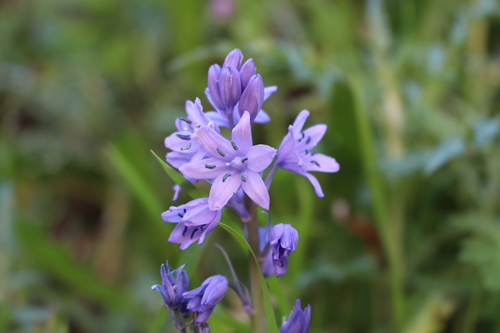
Hyacinthoides paivae is a perennial bulb-growing plant. Its bulbs typically measure 17–30 mm by 13–30 mm (0.67–1.18 in by 0.51–1.18 in). Each bulb produces 4–7 basal leaves; 2–12 leaves occur more rarely. Individual leaves are 20–50 cm (7.9–19.7 in) long and 7–12 mm (0.28–0.47 in) wide. Stems grow 22–45 cm (8.7–17.7 in) long, and each stem bears an inflorescence of 6–18 flowers arranged in a multilateral raceme. Each flower attaches to a 5–7 mm (0.20–0.28 in) long pedicel, and the flower itself measures 12–22 mm (0.47–0.87 in) long by 2–3 mm (0.08–0.12 in) wide. H. paivae can be distinguished from H. italica by its broader leaves and larger flowers. It differs from H. hispanica, which has longer, narrower, unscented, bell-shaped flowers. Hyacinthoides paivae is endemic to the north-western Iberian Peninsula. Its range includes western Galicia (the Spanish provinces of A Coruña, Ourense, and Pontevedra) and north-western Portugal (the provinces of Beira Litoral, Douro Litoral, Minho, and Trás-os-Montes). Unidentified plant material collected from Sierra de la Demanda, a small mountain range on the border of Spain's Burgos province and La Rioja, genetically matches H. paivae. This species grows in oak woodland, pine woodland over understory shrubs including Ulex, Erica cinerea and Cistus species, and other shady habitats. It also occurs occasionally on coastal cliffs and in mown meadows. Its typical flowering period is March and April, though flowering can be delayed until as late as June in upland areas like Monte Pindo.