About Hyacinthoides non-scripta (L.) Chouard ex Rothm.
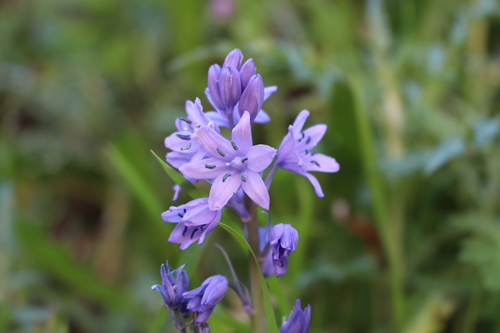
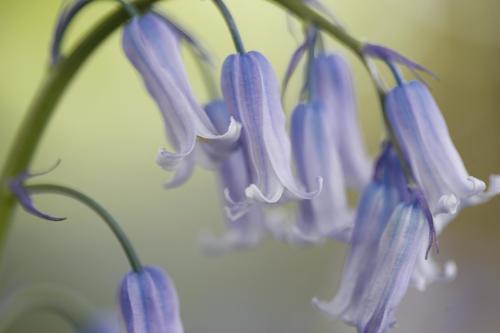
Hyacinthoides non-scripta (L.) Chouard ex Rothm. is a perennial bulb-growing plant. It produces 3 to 6 linear basal leaves, each 7–16 millimetres (0.28–0.63 in) wide. Its inflorescence holds 5–12 flowers (exceptionally 3–32) on a stem up to 500 mm (20 in) tall, which droops at the tip; flowers are arranged in a 1-sided nodding raceme. Each flower is 14–20 mm (0.55–0.79 in) long, with two basal bracts, and six violet-blue tepals that are strongly recurved at their tips. The three outer whorl stamens are fused to the perianth for more than 75% of their length, and produce cream-coloured pollen. The flowers have a strong, sweet scent. Seeds are black and germinate on the soil surface. The bulbs grow contractile roots; when these roots contract, they pull the bulb down into deeper, moister soil layers, reaching final depths of 10–12 cm (3.9–4.7 in). This growth pattern may explain why H. non-scripta is absent from some thin chalk soils in South East England, where bulbs cannot reach sufficiently deep soil.
This species differs from the introduced H. hispanica found in Britain and Ireland in several key traits. H. hispanica has paler flowers arranged in radially symmetrical racemes, less recurved tepals, and only a faint scent. Its outer stamens are fused to tepals for less than 75% of their length, and anthers match the color of the tepals. The two species are thought to have diverged 8000 years ago, and hybridise readily to produce fertile offspring called Hyacinthoides × massartiana. These hybrids are intermediate between the two parent species, forming a continuous spectrum of variation that connects the two.
Hyacinthoides non-scripta is native to western parts of Atlantic Europe, ranging from north-western Spain and north-western Portugal to the Netherlands, Great Britain, and Ireland. It has been recorded in Belgium, Great Britain, France, Ireland, Portugal, the Netherlands and Spain, and occurs as a naturalized species in Germany, Italy and Romania. It has been introduced, and is often highly invasive, in multiple parts of North America: the Pacific Northwest (British Columbia, Washington and Oregon), the Great Lakes region (Ontario, New York, Ohio and Pennsylvania), other parts of the United States including the Virginias, Kentucky and Indiana, and also New Zealand.
Despite its broad distribution, H. non-scripta reaches its highest densities in Britain and Ireland, where "bluebell woods"—spring woodlands with understories dominated by this species—are a well-known feature. It is found across almost all of Britain and Ireland, except the northern Outer Hebrides (Lewis and Harris), Orkney and Shetland, and an estimated 25%–50% of all common bluebells globally occur in Britain and Ireland. Across most of its range, H. non-scripta grows in deciduous woodland, flowering and leafing out early before the tree canopy closes in late spring. It can also grow under bracken or Japanese knotweed, both perennials that form dense summer canopies. It grows best on slightly acid soils; in alkaline conditions, the same niche is often occupied by other species such as Mercurialis perennis. Adapted to woodland habitats, its young shoots can penetrate thick layers of leaf litter, so bluebells are often used as an indicator species for ancient woodland. They are also common in hedgerows, and in the western part of their range can grow in open habitats including coastal meadows.
Bluebell flowers are rich in pollen and nectar, and are primarily pollinated by bumblebees, though various other insects also visit the flowers. They act as a host for the parasitic fungus Uromyces muscari, which causes the disease bluebell rust. The presence of arbuscular mycorrhizae in bluebell roots greatly enhances the species' ability to absorb phosphorus from soil.
Bluebells have been used for many purposes over centuries. There is little evidence of widespread medicinal use historically, but the bulbs contain mucilage and inulin, a starchy substance that was used as glue for bookbinding. During the Elizabethan era, starch from bluebell bulbs was used to stiffen the fabric of ruffs and collars. Today, bluebells are widely planted as garden plants, grown among trees or in herbaceous borders. They flower at the same time as hyacinths, Narcissus and some tulips. They produce seed and reproduce vegetatively via bulb offsets, so they can spread rapidly and may need to be controlled as garden weeds.
Like other members of its genus, bluebells, especially their bulbs, are generally considered toxic. Bluebells produce a wide range of chemicals with potential medicinal properties: they contain at least 15 biologically active compounds that may protect them from insects and animals. Certain water-soluble pyrrolidine alkaloid extracts from bluebells are similar to compounds that have been tested for use in fighting HIV and cancer. In folk medicine, bluebell bulbs are used as a remedy for leucorrhoea, and as a diuretic or styptic, while bluebell sap can be used as an adhesive.