About Hyacinthoides hispanica (Mill.) Rothm.
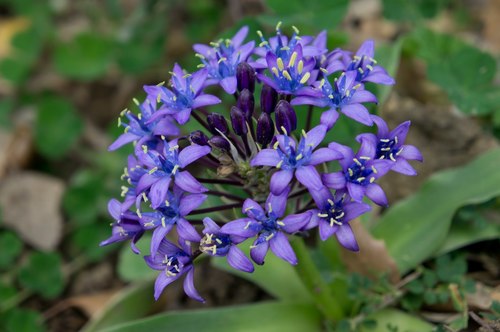
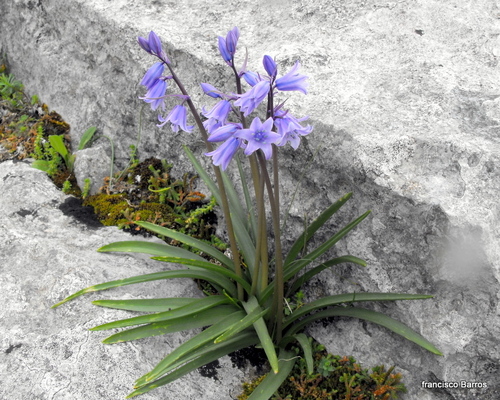
Hyacinthoides hispanica, commonly called Spanish bluebell, can be distinguished from the common bluebell (Hyacinthoides non-scripta) by several traits. Its blue flowers are larger, paler, and less pendulous, and they do not all droop to one side as common bluebell flowers do. It has a more erect flower stem (raceme), broader leaves, and blue anthers, while common bluebells have creamy-white anthers. It has little or no floral scent, in contrast to the strong fragrance of the common northern bluebell. Like common bluebells, Spanish bluebells also occur in pink- and white-flowered forms. Hyacinthoides hispanica is native to the western Iberian Peninsula, which includes Portugal and western Spain, and excludes the far northwest of the region. It is cultivated and has become naturalized in many other European countries, as well as in North America and Australia. It was introduced to the United Kingdom in the late 17th century. Since its introduction, it has frequently hybridized with the UK's native common bluebell, and the resulting hybrid, named Hyacinthoides × massartiana, is regarded as invasive. Both Spanish bluebells and this hybrid produce highly fertile seed, but it is generally the hybrid that invades habitats where native common bluebells grow. This invasion has led to the common bluebell being considered a threatened species. Spanish bluebell is also cultivated as a garden plant, and several named cultivars exist with flowers in various shades of white, pink, and blue.