About Hura crepitans L.
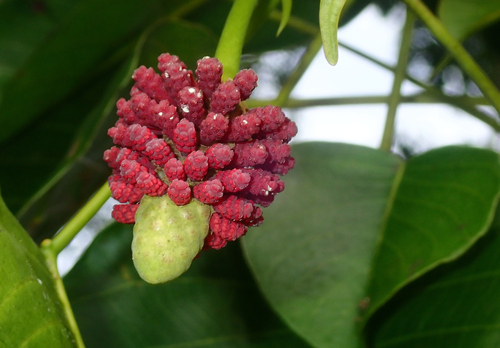
Hura crepitans L., commonly called the sandbox tree, can reach up to 60 metres (200 ft) in height, and can measure up to 13.2 metres (43 ft) in girth at 1.8 m (6 ft) above ground level. Its large ovate leaves can grow to 60 cm (2 ft) wide. This species is monoecious, producing red flowers that lack petals. Male flowers develop on long spikes, while female flowers grow individually in leaf axils. The trunk is covered in long, sharp spikes that secrete poisonous sap. Its fruits are large, pumpkin-shaped capsules 3–5 cm (1–2 in) long and 5–8 cm (2–3 in) in diameter, with 16 radially arranged carpels. The seeds are flattened, around 2 cm (3⁄4 in) in diameter. When ripe, the fruit capsules explode, splitting into segments and launching seeds at 70 m/s (250 km/h; 160 mph). Different sources report different maximum distances the seeds can travel: one notes ripe capsules can catapult seeds as far as 100 m (330 ft), while another states seeds can travel as far as 45 m (150 ft) from the parent tree, most commonly landing 30 m (100 ft) away. High-speed video analysis of the exploding fruit found that sandbox tree seeds fly with backspin, rather than the previously assumed topspin. This backspin helps the seeds stay oriented to minimize air drag during flight. The sandbox tree is a tropical species that prefers warmer, more humid environments, wet soil, and either partial shade or partial to full sun. It is often cultivated as a shade tree. Indigenous peoples used the tree’s lightweight wood to make canoes. Fishermen have been recorded using the tree’s milky, caustic sap to poison fish. The Carib people produced arrow poison from this sap. The wood is used to make furniture, sold under the name "hura". Before modern ink drying methods, when most writing pens left wet ink on the page, the tree’s unripe seed capsules were sawn in half to create decorative boxes, also called pounce pots, to hold the sand used to dry wet ink. This use gave the tree its common name, sandbox tree. Extracts from Hura crepitans have also been documented as herbal remedies. The seeds contain an oil that is toxic when ingested, but this oil can be processed into biodiesel and soap. After extracting the oil from the seeds, the remaining starchy material can be cooked and turned into animal feed.